

Software development has progressed from traditional release cycles to agile workflows, cloud-native platforms, and CI/CD practices. Now, AI-native DevOps is emerging as the next stage in this evolution.
Unlike conventional automation tools that follow predefined instructions, AI agents can analyze information, identify patterns, recommend actions, and perform tasks across development and operations workflows. Today, they are used across application development, testing, deployments, and operations management.
AI-powered DevOps brings intelligence into everyday operations, supporting areas such as code generation, testing, deployment management, incident response, and infrastructure monitoring. This article explores how AI DevOps is changing modern development practices, its advantages, challenges, and key DevOps trends shaping the future.
What Is AI-Native DevOps?
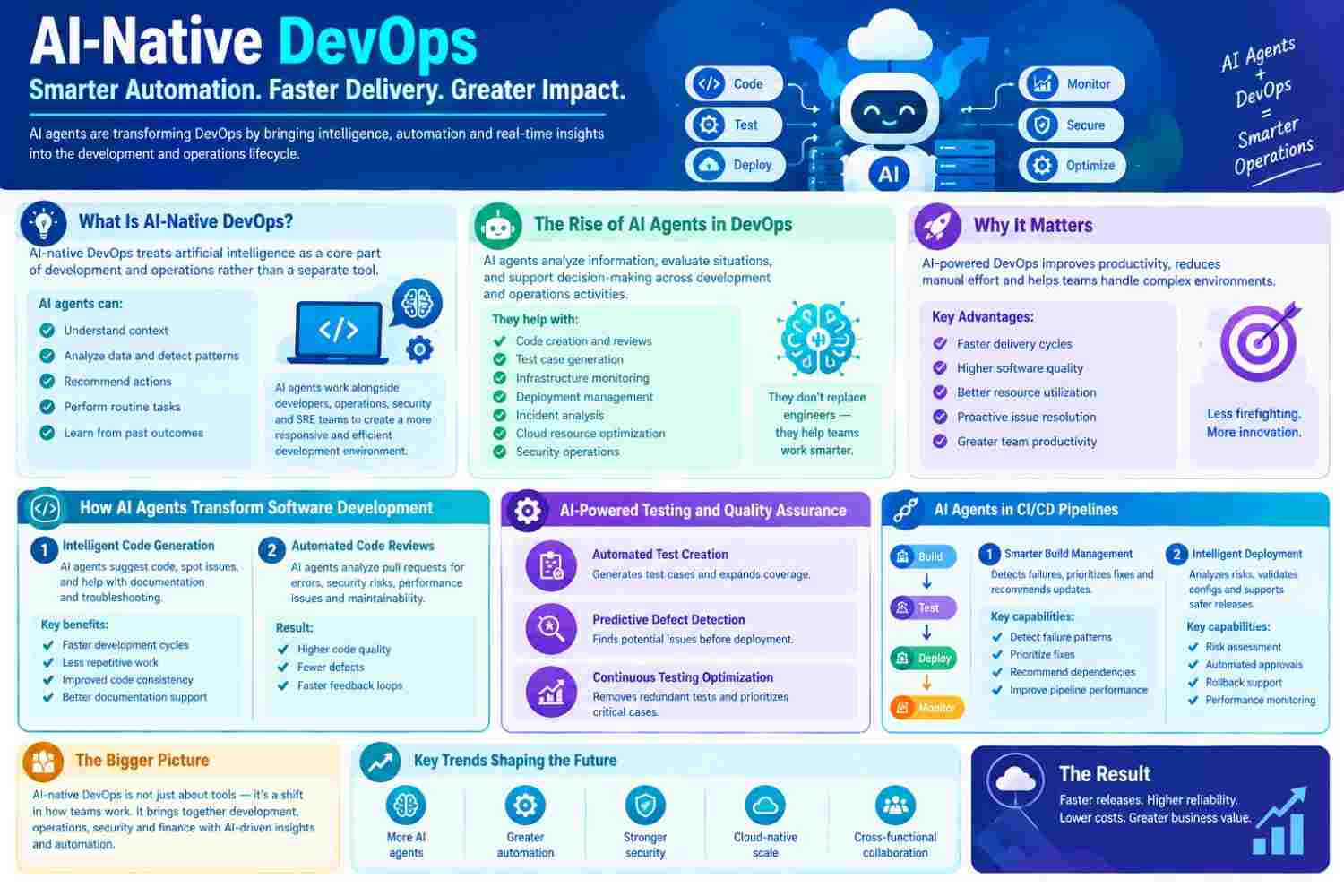
AI-native DevOps treats artificial intelligence as a core part of development and operations rather than a separate tool.
Traditional DevOps automation relies on predefined workflows and rule-based actions. In contrast, AI-driven systems can:
- Understand context
- Analyze operational and development data
- Detect patterns and anomalies
- Recommend actions
- Perform routine tasks
- Learn from past outcomes
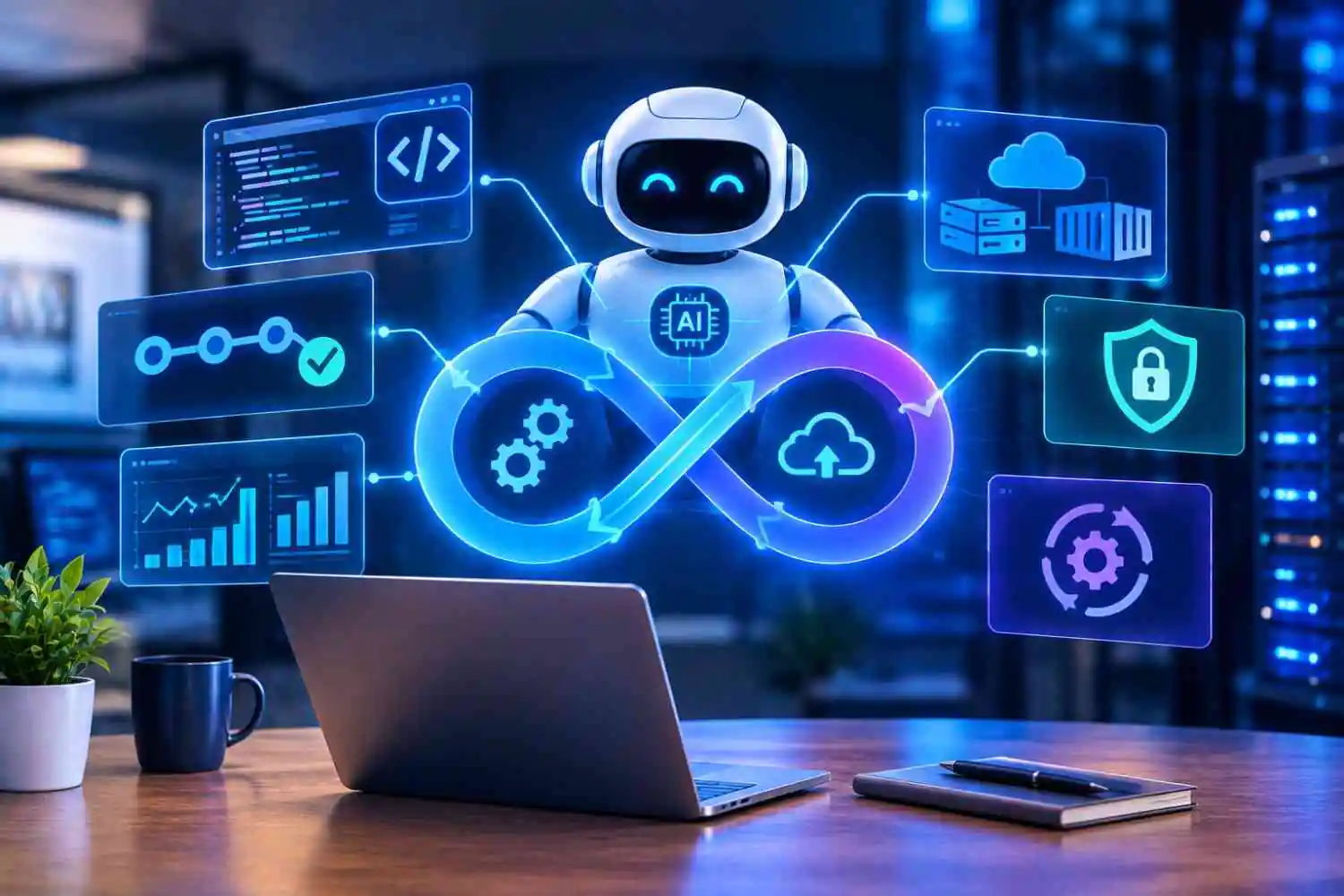
In this environment, AI agents act as collaborative assistants for developers, operations teams, security professionals, and site reliability engineers. The combination of automation and intelligence creates a more responsive intelligent DevOps model that helps teams manage complex environments with less manual effort.
The Rise of AI Agents in DevOps
AI agents are becoming an important part of intelligent DevOps environments. Unlike traditional automation tools that follow predefined instructions, these systems can analyze information, evaluate situations, and support decision-making across development and operations activities.
In software delivery, AI agents can assist with:
- Code creation and reviews
- Test case generation
- Infrastructure monitoring
- Deployment management
- Incident analysis
- Cloud resource optimization
- Security operations
Rather than replacing engineers, AI agents help teams handle repetitive and data-heavy tasks more efficiently. For organizations dealing with complex environments and limited resources, they provide a practical way to improve productivity while allowing technical teams to focus on higher-value work.
How AI Agents Transform Software Development
1. Intelligent Code Generation
Developers often spend time writing repetitive code, creating documentation, and troubleshooting common issues. AI agents can assist by generating code suggestions, identifying improvements, and helping teams work through development challenges. They can also analyze project context and existing code to provide relevant recommendations.
Key benefits include:
- Faster development cycles
- Reduced repetitive coding work
- Improved code consistency
- Better documentation support
2. Automated Code Reviews
Code reviews help maintain software quality, but they can slow down development when teams are under pressure. AI agents can review pull requests and identify coding errors, security risks, performance concerns, and maintainability issues. This allows engineers to focus more on architecture and business requirements while supporting faster software delivery.
AI-Powered Testing and Quality Assurance
Testing remains a critical part of software delivery, but traditional approaches can struggle to keep pace with frequent releases. In AI-powered DevOps, AI agents help improve testing processes by analyzing application behavior, requirements, and historical defect data.
Automated Test Creation
AI agents can generate test cases automatically, helping teams expand coverage while reducing manual effort.
Benefits include:
- Broader test coverage
- Faster validation cycles
- Reduced manual testing effort
- Earlier defect identification
Predictive Defect Detection
One of the most practical applications of AI DevOps is identifying potential defects before deployment. By analyzing bug history, code changes, testing results, and deployment patterns, AI tools help teams focus on areas that present a higher risk.
Continuous Testing Optimization
AI can also evaluate the effectiveness of testing activities over time. It helps teams identify redundant tests, prioritize critical test cases, and support faster CI/CD workflows. This contributes to better software quality while reducing testing overhead.
AI Agents in CI/CD Pipelines
Continuous integration and continuous delivery are central to modern software delivery practices. Within AI-powered DevOps, AI agents add intelligence to CI/CD workflows by helping teams identify issues and improve deployment decisions.
1. Smarter Build Management
AI agents can monitor pipelines, detect recurring failures, identify dependency-related issues, and recommend corrective actions. This helps reduce delays caused by repeated build errors.
Key capabilities include:
- Detecting build failure patterns
- Prioritizing fixes
- Recommending dependency updates
- Improving pipeline performance
2. Intelligent Deployment Decisions
Using application metrics, infrastructure health data, and recent code changes, AI systems can evaluate deployment risks and help teams decide whether to proceed, pause, or roll back a release.
3. Automated Rollbacks
When issues occur after deployment, AI tools can detect abnormal behavior, identify the source of the problem, trigger rollbacks, and alert relevant teams. This helps reduce disruptions and supports more reliable releases.
Infrastructure Management in AI-Native DevOps
Modern cloud environments generate large volumes of operational data, making infrastructure management more complex. These capabilities are also influencing how organizations approach DevOps Engineering Services, particularly in cloud infrastructure management and operational support.
Dynamic Resource Allocation
AI agents can automatically adjust resources based on workload demands. Their capabilities include:
- Monitoring usage patterns
- Predicting workload fluctuations
- Allocating resources automatically
- Reducing unnecessary cloud spending
Capacity Planning
AI tools analyze infrastructure and application data to support more accurate forecasting. This helps teams plan capacity requirements before performance issues arise.
Infrastructure Health Monitoring
In AI-native DevOps, AI-driven monitoring platforms can:
- Detect unusual activity
- Identify performance degradation
- Correlate events across systems
- Highlight potential risks
These insights help operations teams address issues earlier and maintain application availability.
Improving Incident Management with AI Agents
System outages can affect both business operations and customer experience. In intelligent DevOps environments, AI agents play an important role in incident detection and response.
Faster Root Cause Analysis
Investigating incidents often involves reviewing large volumes of operational data. AI agents can analyze:
- Application logs
- Infrastructure events
- Network activity
- System dependencies
This helps teams identify the likely cause of an issue more quickly.
Intelligent Alert Management
Modern environments generate thousands of alerts. AI-powered tools help by:
- Filtering irrelevant notifications
- Grouping related alerts
- Prioritizing critical incidents
- Reducing duplicate warnings
Automated Resolution Workflows
For recurring issues, AI agents can perform actions such as restarting services, adjusting resources, or triggering recovery processes. This supports faster response times and improves overall service reliability.
AI-Native DevOps and Security
Security remains a critical part of software delivery, especially as applications become more distributed and cloud-based. Within AI-native DevOps, AI-driven tools help teams identify risks and respond to security issues more effectively.
1. Continuous Threat Detection
AI systems can analyze security data in real time to identify:
- Suspicious login attempts
- Unusual network activity
- Unauthorized access patterns
- Potential malware behavior
This helps security teams detect threats earlier.
2. Vulnerability Management
AI agents can scan applications and infrastructure throughout the development lifecycle. Key benefits include:
- Early risk identification
- Faster patch prioritization
- Better security visibility
- Reduced exposure to known vulnerabilities
3. Securing the Software Supply Chain
AI tools can evaluate software dependencies, third-party libraries, and container images for security risks. These capabilities help organizations strengthen application security and support intelligent DevOps practices across the development process.
Benefits of AI-Powered DevOps
Organizations adopting AI-powered DevOps are seeing improvements across development, operations, and infrastructure management. By combining automation with data-driven insights, teams can handle growing software complexity more effectively.
Key benefits include:
- Higher productivity: AI agents take over repetitive tasks, allowing teams to focus on development and problem-solving.
- Faster release cycles: Development, testing, and deployment activities move more quickly.
- Improved reliability: Predictive analysis and automated response mechanisms help reduce downtime.
- Better resource utilization: AI supports efficient use of cloud and infrastructure resources.
- Stronger decision-making: Teams gain deeper visibility into operational data and potential risks.
- Improved collaboration: Shared insights help development, operations, and security teams work more closely.
Challenges of Implementing AI-Native DevOps
While AI-native DevOps offers several advantages, organizations may encounter obstacles during implementation. Factors such as data quality, integration requirements, and organizational readiness can influence outcomes.
1. Data Quality Issues
AI systems depend on reliable data. Incomplete or inaccurate information can affect recommendations and operational decisions.
2. Trust and Transparency
Teams may be reluctant to rely on AI-driven recommendations if the reasoning behind them is unclear. Visibility into how decisions are made remains important.
3. Integration Complexity
Many enterprises still rely on legacy systems. Connecting modern AI capabilities with existing infrastructure often requires time, planning, and investment.
4. Governance and Compliance
Organizations need policies covering:
- Data access and usage
- AI decision-making processes
- Model monitoring
- Risk management
- Regulatory requirements
5. Skills and Cultural Change
Successful adoption depends on employee preparedness. Training and collaboration initiatives help teams work more with AI agents and support the transition toward intelligent DevOps practices.
The Future of Intelligent DevOps
The future of intelligent DevOps is likely to involve greater use of autonomous systems across development and operations. AI agents are expected to take on a broader range of responsibilities throughout the software delivery lifecycle.
Future capabilities may include:
- Coordinating activities across teams
- Supporting end-to-end development tasks
- Analyzing application architectures
- Validating code changes
- Identifying potential outages early
- Managing multi-cloud environments
Organizations are also exploring collaboration between multiple AI systems to handle complex operational tasks. As DevOps environments become more automated, human expertise will remain central to strategy, governance, architecture, and business decision-making. The combination of human judgment and AI-driven insights will shape the next stage of DevOps adoption.
Conclusion
AI-native DevOps is bringing a new approach to how organizations build, test, deploy, and maintain applications. By introducing intelligence across the software delivery lifecycle, teams can make better use of data and reduce dependence on manual processes.
Today, AI agents support activities ranging from software development and testing to infrastructure management, incident response, and security monitoring. Their ability to analyze large volumes of information helps teams respond to issues faster and make decisions.
Challenges related to data quality, governance, transparency, and integration still need attention. Even so, AI-powered DevOps is gaining adoption across enterprises. Organizations that combine technical expertise with AI capabilities are likely to see stronger outcomes in software delivery and operations.
FAQs
1. What is AI-native DevOps?
AI-native DevOps integrates artificial intelligence throughout the software lifecycle, allowing systems to analyze operational and development data, recommend actions, automate routine tasks, and support teams in managing applications more effectively.
2. How do AI agents support software delivery?
AI agents support software delivery by assisting with code generation, testing, deployments, infrastructure monitoring, incident response, and resource management. This helps teams reduce manual effort and improve the consistency of operational processes.
3. What is the difference between DevOps automation and AI DevOps?
Traditional DevOps automation relies on predefined rules and workflows. AI DevOps uses machine learning and AI agents that can analyze data, identify patterns, recommend actions, and improve performance based on previous outcomes.
4. Can AI agents replace DevOps engineers?
No. AI agents are designed to support DevOps professionals rather than replace them. Engineers remain responsible for architecture, governance, security decisions, business priorities, and situations that require experience and contextual judgment.
5. How does AI improve CI/CD pipelines?
AI improves CI/CD pipelines by identifying build failures, assessing deployment risks, analyzing performance data, recommending fixes, and supporting rollback decisions. These capabilities help teams release software with greater confidence.
6. What are the biggest challenges of adopting AI-native DevOps?
Organizations adopting AI-native DevOps often face challenges related to data quality, legacy system integration, governance policies, transparency of AI-driven decisions, regulatory requirements, and workforce readiness for new technologies.
7. Why is AI-powered DevOps becoming a major DevOps trend?
AI-powered DevOps helps organizations manage large volumes of development and operational data more effectively. By supporting faster issue detection, deployment decisions, testing activities, and infrastructure management, it addresses many challenges associated with modern software delivery.