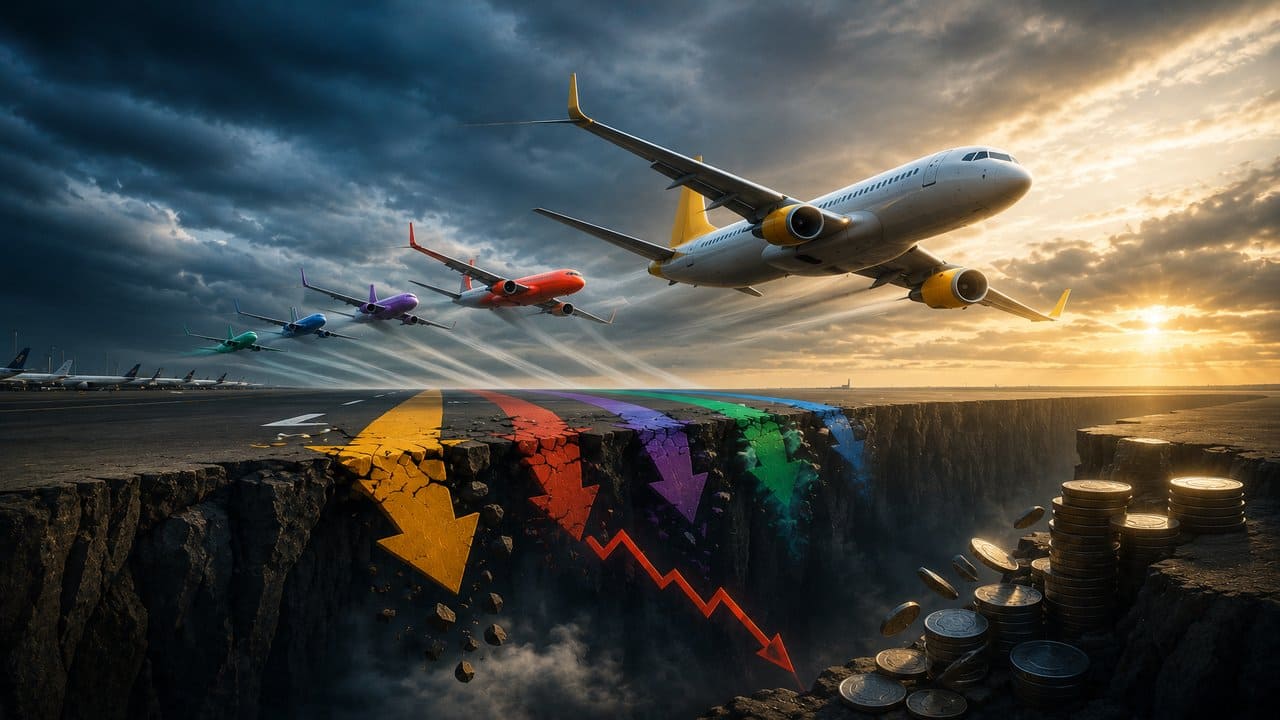



We are living in the most paradoxical moment in aviation history:
- Demand is high.
- Technology is exploding.
- Capital is available. And yet – airlines are failing faster than ever.
- Spirit’s collapse wasn’t an anomaly. It was a signal flare for the entire industry.
“Bankruptcy is never a financial event. It is always a governance event.”
“Airlines don’t go bankrupt because of one bad quarter. They go bankrupt because the humans in the loop stop seeing the cliff.”
Executive Foreword
“Airlines don’t go bankrupt because of one bad quarter. They go bankrupt because the humans in the loop stop seeing the cliff.”
North American aviation is experiencing a paradox:
- Demand is strong
- Technology is accelerating
- Capital is available
Yet carriers are failing faster than at any point in the last two decades.
Spirit’s collapse was not an outlier – it was a signal flare for every boardroom and C‑suite in the sector.
“Bankruptcy is never a financial event. It is always a governance event.”
1. The Model That Broke Itself
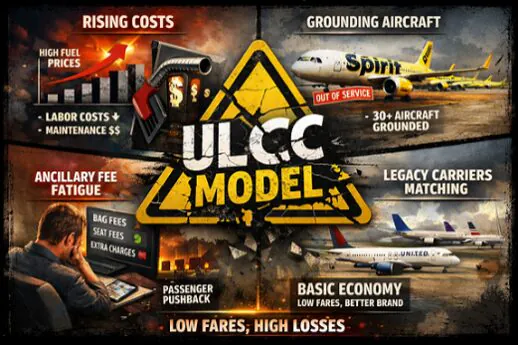
The ULCC model didn’t fail – it aged out.
Broken ULCC Model Visual
For 20 years, the formula was simple:
- Fly cheap
- Charge fees
- Keep planes full
- Pray fuel stays low
But 2026 is not 2006.
“You can’t run a 2026 airline on a 2006 playbook.”
The model cracked under:
- Rising structural costs
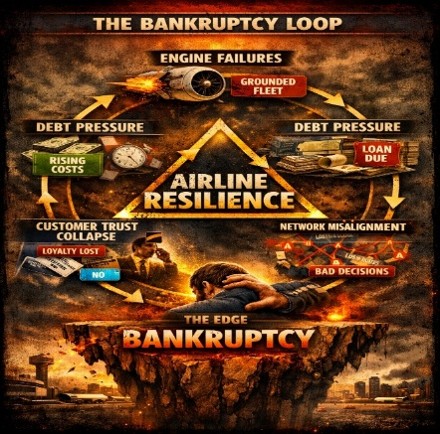
- Engine reliability failures
- Customer expectations shifting upward
- Competitors copying the playbook
- Ballooning debt
“When your cost base rises faster than your fees, the model isn’t low‑cost – it’s low‑survival.”
2. The Human‑in‑the‑Loop Breakdown
Spirit’s collapse was not driven by engines, fuel, or debt.
It was driven by silence.
Warning signals were everywhere:
- Engine reliability alerts
- Route profitability erosion
- Customer trust collapse
- Debt maturity cliffs
- Merger failure shockwaves
But the escalation chain failed.
“The data screamed. The dashboards whispered. The humans stayed quiet.”
This is the governance gap that kills airlines:
- The wrong humans were in the loop
- The right humans were out of the loop
- The loop itself was fragmented across silos
“If everyone owns the risk, no one escalates the risk.”
3. The Technology That Could Have Prevented Collapse
Technology doesn’t prevent bankruptcy. It prevents the conditions that lead to bankruptcy.
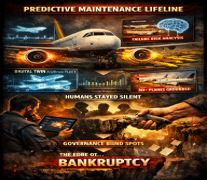
Predictive Maintenance
The GTF crisis didn’t need to be fatal. Predictive models could have forecast:
- Failure clusters
- Spare engine shortages
- Utilization impacts
- Compensation leverage
- Fleet substitution needs
“Predictive maintenance isn’t about fixing engines. It’s about fixing cash flow.”
Network Optimization AI
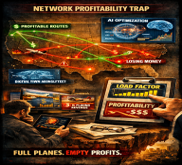
- Spirit kept flying full planes that still lost money.
- “A full plane losing money is still losing money.”
Dynamic Pricing & Retailing
- ULCCs needed to evolve from “cheap seats” to “smart retail.”
- “If you’re not a retailer, you’re a commodity.”
Disruption Automation
- Automation should have protected customer trust – not eroded it.
- “Customers don’t remember the delay. They remember the silence.”
Scenario Simulation Engines
Spirit needed a digital twin of the business to model:
- Merger failure
- Fleet groundings
- Fuel shocks
- Credit tightening
“If you can simulate the storm, you don’t drown in it.”
4. The New Governance Loop: Human + Machine + Architecture
The future of aviation resilience is not automation – it is orchestration.
Winning carriers will operate a three‑layer governance loop:
1. Machine Intelligence
Predictive. Real‑time. Always‑on.
2. Human Judgment
Context. Escalation. Accountability.
3. Governance Architecture
- Clear roles. Clear thresholds. Clear consequences.
- “AI finds the risk. Humans decide the risk. Governance owns the risk.”
- “Dashboards don’t save airlines. Decisions do.”
5. Human‑in‑the‑Loop Gaps That Accelerated Spirit’s Bankruptcy
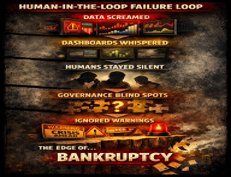
Human-in-the-Loop Failure Loop
A. Fleet & Engine Risk Escalation
Pratt & Whitney GTF issues were known years in advance, yet Spirit failed to:
- Elevate risk to the board
- Model worst‑case groundings
- Secure contingency aircraft
- Negotiate compensation
- Diversify fleet risk
Missing role: The Constraint Keeper
B. Financial Oversight & Debt Strategy
Debt became unsustainable, but decisions were dominated by:
- Automated models
- Optimistic forecasts
- Delayed restructuring
Missing role: The Accountability Owner
C. Network & Scheduling Decisions
Automated tools optimized for load factor, not margin.
Missing role: The Context Holder
D. Customer Experience & Brand Trust
Automation overwhelmed customers during disruptions.
Missing role: The Empathy Operator
E. Strategic Direction After the JetBlue Merger Failure
Leadership delayed the pivot.
Missing role: The Strategic Integrator
6. Boardroom‑Level Insight
The next five years will not reward the fastest airline. They will reward the most adaptive airline. “The winners will be the carriers that treat governance as a system, technology as a force multiplier, and humans as the irreplaceable center of judgment.”
“Aviation doesn’t need more dashboards. It needs more leaders who know when to override them.”
Spirit’s bankruptcy was not a financial inevitability — it was a governance failure.
Automation replaced judgment. Dashboards replaced escalation. Silos replaced accountability.
The result: a preventable collapse.
7. The Call to Action for North American Aviation Leaders
The paradox of full planes but empty profits, with red and green route lines, AI overlays, and the executive hand pointing at the wrong metric. A visual metaphor for how automation optimized the wrong outcome.
“Bankruptcy is optional. Blindness is not.”
Every carrier now faces the same strategic choice:
- Evolve the model or defend the model
- Integrate humans and machines or let silos run the business
- Build resilience or wait for the next shock
The next five years will reward adaptiveness, not speed.
“The winners will be the carriers that treat governance as a system, technology as a force multiplier, and humans as the irreplaceable center of judgment.”
“The Bankruptcy Loop” -a circular flow of failure, from engine breakdowns to leadership silence, ending at the fiery cliff of bankruptcy
THE META-LEVEL INSIGHT
Spirit’s bankruptcy wasn’t just financial – it was a governance failure. Automation, dashboards, and models replaced human judgment at the exact moment when human judgment mattered most.
The Resilience Governance Triangle” – governance at the apex, machine intelligence and human judgment anchoring the base, all converging on airline resilience
The wrong humans were in the loop. The right humans were out of the loop. And the loop itself was fragmented across silos.

THE BOARDROOM SUMMARY
Yes – human‑in‑the‑loop gaps absolutely fed Spirit’s bankruptcy path. The collapse was accelerated by failures in:
- fleet risk escalation
- debt governance
- network profitability oversight
- customer trust management
- post‑merger strategic pivoting
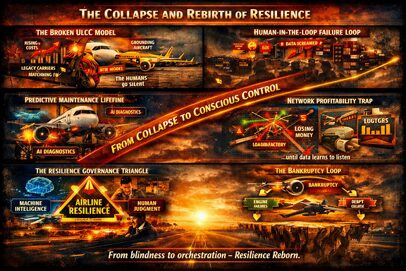
“The Collapse and Rebirth of Resilience”
Top : “The Broken ULCC Model” and “Human‑in‑the‑Loop Failure Loop” side by side – the cause layer
Middle : “Predictive Maintenance Lifeline” and “Network Profitability Trap” – the response layer
Bottom : “Resilience Governance Triangle” and “Bankruptcy Loop” – the resolution layer
A glowing diagonal thread connects all six, “From Blindness to Orchestration.”
8. Executive Engagement & Leadership Programs
To explore our governance, resilience, and HITL leadership programs, please provide:
- Name
- Address
- Organization
- Role
Our team will follow up with upcoming session details.
Information on upcoming workshops
Visit: www.leaders-hive.com