



As businesses continue to modernize their digital operations, IT leaders are under pressure to deliver applications faster, support growing customer demands, and keep systems resilient. Traditional IT environments often struggle to meet these expectations because they were built for a different era of computing.
Cloud-native architecture is not simply about moving applications to the cloud. It is an approach to designing, building, and operating applications specifically for cloud environments. Organizations that embrace cloud-native practices can improve application scalability, accelerate software delivery, and adapt more quickly to changing business requirements. For enterprise IT leaders, understanding cloud-native architecture is essential for building future-ready technology ecosystems.
Understanding Cloud-Native Architecture
Cloud-native architecture refers to the design and development of applications that fully leverage cloud computing capabilities. These applications are built to run in dynamic environments such as public, private, or hybrid clouds.
Unlike traditional monolithic applications that are tightly coupled and difficult to modify, cloud-native applications are flexible, distributed, and designed for rapid change.
A cloud-native application typically relies on:
- Microservices
- Containers
- Kubernetes or container orchestration platforms
- Application Programming Interfaces (APIs)
- DevOps practices
- Continuous Integration and Continuous Delivery (CI/CD)
- Automation and infrastructure as code
Together, these technologies create applications that can scale quickly, recover from failures efficiently, and support frequent updates without major disruptions.
Why Cloud-Native Architecture Matters
Modern enterprises operate in highly competitive environments where customer expectations change rapidly. Organizations need systems that can evolve continuously without lengthy development cycles.
Cloud-native architecture offers several advantages:
- Faster software development and deployment
- Better application scalability
- Improved reliability and availability
- Lower infrastructure management overhead
- Enhanced operational flexibility
- Easier integration with emerging technologies
For IT leaders, this means the ability to launch new services, support digital transformation initiatives, and respond to market demands more effectively.
Core Components of Cloud-Native Architecture
1. Microservices
Microservices divide an application into smaller, independent services that perform specific functions.
For example, in an e-commerce platform, separate microservices may handle:
- Product catalog management
- User authentication
- Shopping cart operations
- Payment processing
- Order fulfillment
Because each microservice operates independently, development teams can update one service without impacting the entire application.
Benefits include:
- Faster updates
- Improved fault isolation
- Greater development agility
- Independent scalability
2. Containers
Containers package an application along with its dependencies into a portable unit that can run consistently across different environments.
Popular container technologies include:
- Docker
- Podman
- containerd
Containers help organizations eliminate compatibility issues that often arise between development, testing, and production environments.
Key benefits include:
- Consistent deployments
- Faster application startup
- Efficient resource utilization
- Improved portability
3. Kubernetes and Container Orchestration
Managing hundreds or thousands of containers manually is impractical. Kubernetes automates container deployment, scaling, monitoring, and management. It has become the dominant orchestration platform for cloud-native applications.
With Kubernetes, organizations can:
- Automatically scale workloads
- Restart failed containers
- Balance traffic across applications
- Manage application updates with minimal downtime
This automation plays a major role in maintaining application reliability.
4. DevOps Practices
Cloud-native architecture and DevOps often go hand in hand. DevOps promotes collaboration between development and operations teams throughout the software lifecycle.
Common DevOps practices include:
- Automated testing
- Continuous monitoring
- Frequent code releases
- Infrastructure automation
- Shared ownership models
These practices help organizations release software more frequently while maintaining stability.
5. CI/CD Pipelines
Continuous Integration and Continuous Delivery pipelines automate the process of building, testing, and deploying software. Instead of waiting for large release cycles, development teams can roll out smaller updates regularly.
Benefits include:
- Faster deployment cycles
- Reduced human error
- More reliable releases
- Faster issue detection
For enterprises, CI/CD supports innovation without sacrificing application quality.
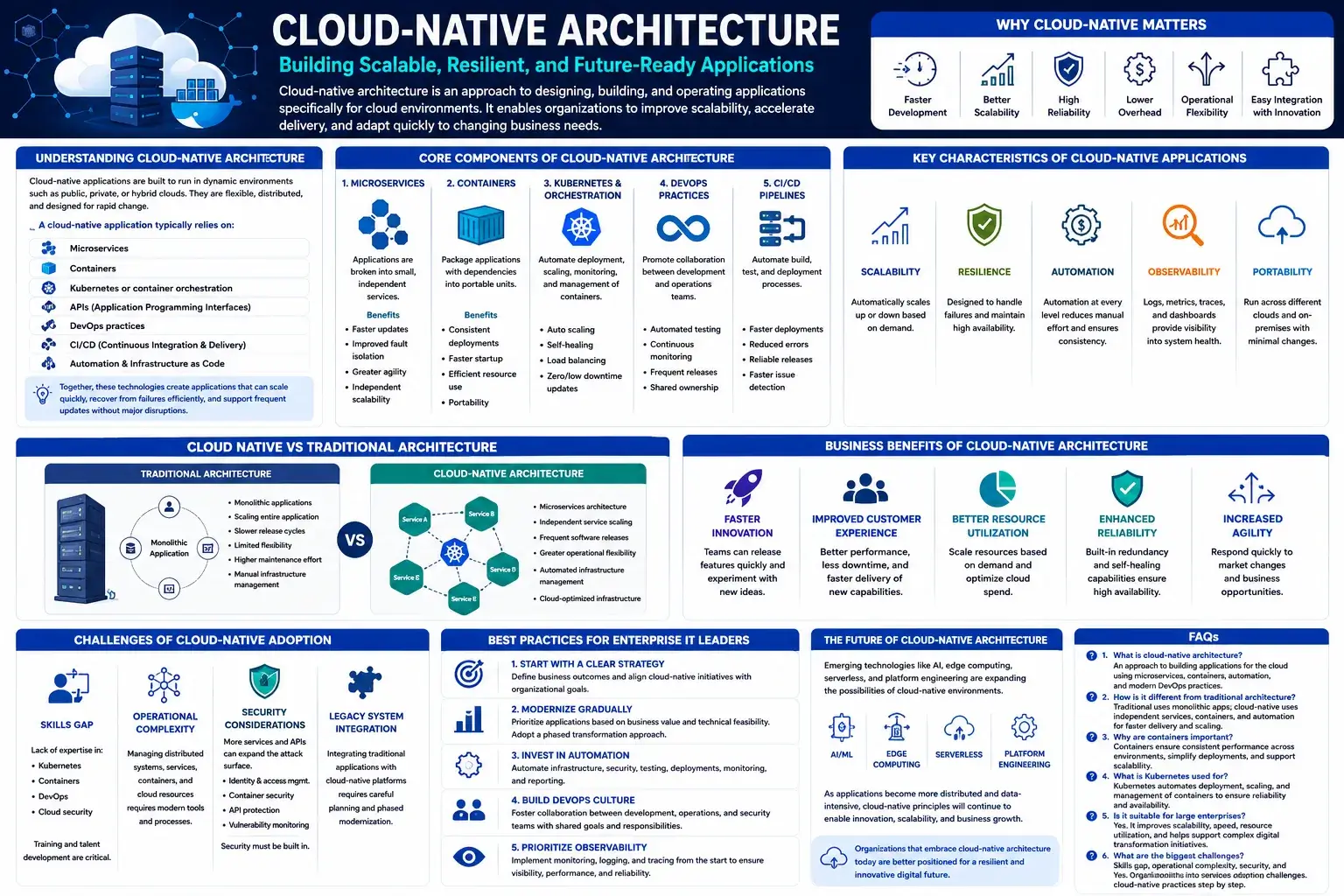
Key Characteristics of Cloud-Native Applications
Cloud-native applications share several common traits.
1. Scalability
Cloud-native applications can automatically scale based on demand. For example, during seasonal shopping events, additional computing resources can be allocated automatically. When demand decreases, resources can be reduced to control costs.
2. Resilience
Failures are inevitable in distributed systems. Cloud-native applications are designed with resilience in mind. If one component fails, other components continue operating. This approach reduces downtime and improves service availability.
3. Automation
Automation is built into cloud-native environments at multiple levels.
Examples include:
- Infrastructure provisioning
- Application deployment
- Security updates
- Monitoring and alerting
- Resource scaling
Automation reduces administrative effort and improves operational consistency.
4. Observability
Observability gives IT teams visibility into system behavior.
Cloud-native environments rely on:
- Logs
- Metrics
- Traces
- Monitoring dashboards
These tools help identify performance issues and troubleshoot problems efficiently.
5. Portability
Applications built using containers can often run across different cloud providers and on-premises environments with minimal modification. This portability provides greater flexibility when selecting infrastructure providers.
Cloud Native vs Traditional Architecture
Understanding the differences between cloud native vs traditional architecture helps IT leaders make informed modernization decisions.
Traditional Architecture
Traditional applications are typically built as monolithic systems where all components operate as a single unit.
Characteristics include:
- Tight coupling between components
- Limited scalability
- Longer release cycles
- Manual infrastructure management
- Higher dependency on specific hardware environments
While these systems may work well for stable workloads, they often struggle to support modern digital requirements.
Cloud-Native Architecture
Cloud-native applications are designed for agility and scalability from the beginning.
Characteristics include:
- Microservices-based design
- Containerized deployments
- Automated operations
- Dynamic scaling
- Faster software delivery cycles
- Cloud-optimized infrastructure
Comparison at a Glance
Traditional Architecture
- Monolithic applications
- Scaling entire application
- Slower release cycles
- Limited flexibility
- Higher maintenance effort
Cloud-Native Architecture
- Microservices architecture
- Independent service scaling
- Frequent software releases
- Greater operational flexibility
- Automated infrastructure management
For many organizations, cloud-native architecture provides a better foundation for long-term digital growth.
Business Benefits of Cloud-Native Architecture
1. Faster Innovation
Development teams can release features more frequently because changes are isolated within individual services. This reduces deployment risks and promotes experimentation.
2. Improved Customer Experience
Cloud-native applications respond quickly to changing user demands. Organizations can improve application performance, reduce downtime, and deliver new capabilities faster.
3. Better Resource Utilization
Dynamic scaling helps organizations use computing resources more efficiently. Instead of purchasing infrastructure for peak demand, businesses can adjust resources based on actual usage patterns.
4. Enhanced Reliability
Cloud-native systems are designed to tolerate failures. Built-in redundancy and self-healing capabilities help maintain service availability even when individual components experience issues.
5. Increased Operational Agility
Organizations can respond to market opportunities more quickly. New products, services, and features can be developed and deployed without lengthy infrastructure planning cycles.
Challenges of Cloud-Native Adoption
While cloud-native architecture offers significant advantages, adoption is not without challenges.
1. Skills Gap
Many organizations lack expertise in:
- Kubernetes
- Container technologies
- DevOps methodologies
- Cloud security practices
Training and talent development often become critical success factors.
2. Operational Complexity
Managing distributed applications introduces new complexities. IT teams need tools and processes to monitor multiple services, containers, and cloud resources effectively.
3. Security Considerations
A larger number of services and APIs can expand the attack surface.
Organizations should focus on:
- Identity and access management
- Container security
- API protection
- Continuous vulnerability monitoring
Security should be integrated throughout the development lifecycle.
4. Legacy System Integration
Many enterprises still rely on legacy applications that cannot be modernized immediately. Hybrid environments often require careful planning to integrate traditional systems with cloud-native platforms.
Best Practices for Enterprise IT Leaders
Organizations pursuing cloud-native transformation should consider the following practices:
1. Start with a Clear Strategy
Identify business goals before implementing cloud-native technologies. Modernization efforts should support outcomes such as improved agility, faster delivery, or greater scalability.
2. Modernize Gradually
Not every application needs immediate transformation. Many organizations begin by modernizing customer-facing applications while maintaining critical legacy systems.
3. Invest in Automation
Automation supports consistency, speed, and operational efficiency.
Areas to prioritize include:
- Infrastructure provisioning
- Security testing
- Application deployment
- Monitoring and reporting
4. Build DevOps Culture
Technology alone does not create a cloud-native organization. Cross-functional collaboration between development, operations, and security teams is equally important.
5. Prioritize Observability
Monitoring, logging, and tracing capabilities should be part of the architecture from the beginning. Strong visibility helps teams manage increasingly complex environments.
The Future of Cloud-Native Architecture
Cloud-native architecture continues to evolve as organizations pursue digital transformation initiatives. Emerging technologies such as artificial intelligence, edge computing, serverless computing, and platform engineering are expanding the possibilities of cloud-native environments.
As enterprise applications become more distributed and data-intensive, cloud-native principles will play an increasingly important role in supporting business growth and innovation.
Organizations that embrace cloud-native architecture today are better positioned to adapt to future technology shifts while delivering reliable digital experiences to customers and employees.
Conclusion
Cloud-native architecture represents a fundamental shift in how modern applications are designed, developed, and managed. By combining microservices, containers, Kubernetes, automation, and DevOps practices, organizations can build applications that are scalable, resilient, and capable of rapid evolution.
For enterprise IT leaders, the discussion is no longer just about moving workloads to the cloud. It is about creating a technology foundation that supports continuous innovation, operational flexibility, and long-term business success. Understanding the differences between cloud native architecture and cloud native vs traditional approaches can help organizations make smarter modernization decisions and prepare for the future of enterprise computing.
FAQs
1. What is cloud-native architecture?
Cloud-native architecture is an approach to building applications specifically for cloud environments using microservices, containers, automation, and orchestration platforms. It helps organizations create scalable and resilient systems.
2. How is cloud-native architecture different from traditional architecture?
Traditional architecture uses monolithic applications with tightly connected components, while cloud-native architecture relies on independent services, containerization, automation, and flexible scaling for faster application delivery.
3. Why are containers important in cloud-native applications?
Containers package applications and their dependencies into portable units, allowing consistent performance across environments. They simplify deployments, improve resource utilization, and support scalability efforts.
4. What role does Kubernetes play in cloud-native architecture?
Kubernetes automates container deployment, scaling, monitoring, and recovery. It helps organizations manage large, containerized environments efficiently while maintaining application reliability and availability.
5. Is cloud-native architecture suitable for large enterprises?
Yes. Large enterprises benefit from improved scalability, faster development cycles, better resource management, and increased flexibility when supporting complex digital transformation initiatives and workloads.
6. What are the biggest challenges of cloud-native adoption?
Common challenges include skills shortages, operational complexity, security concerns, and integrating legacy applications with modern cloud-native environments while maintaining business continuity and performance requirements.
7. Can legacy applications be migrated to cloud-native architecture?
Yes. Organizations often modernize applications gradually by breaking monolithic systems into services, containerizing workloads, and adopting cloud-native practices through phased transformation strategies.