


Introduction
Artificial intelligence is entering a stage where systems can make decisions, coordinate activities, and complete complex tasks with limited human input. This has led to the rise of agentic AI, which refers to AI systems capable of planning, reasoning, and taking action across business processes.
Many existing environments were built for traditional business applications and may not support the computing, networking, and data requirements associated with advanced AI workloads. Organizations adopting agentic AI need an AI-ready cloud environment supported by modern AI infrastructure, flexible resource allocation, and reliable data availability.
This article examines how agentic AI is influencing cloud architecture and the requirements of a scalable cloud environment.
What Is Agentic AI?
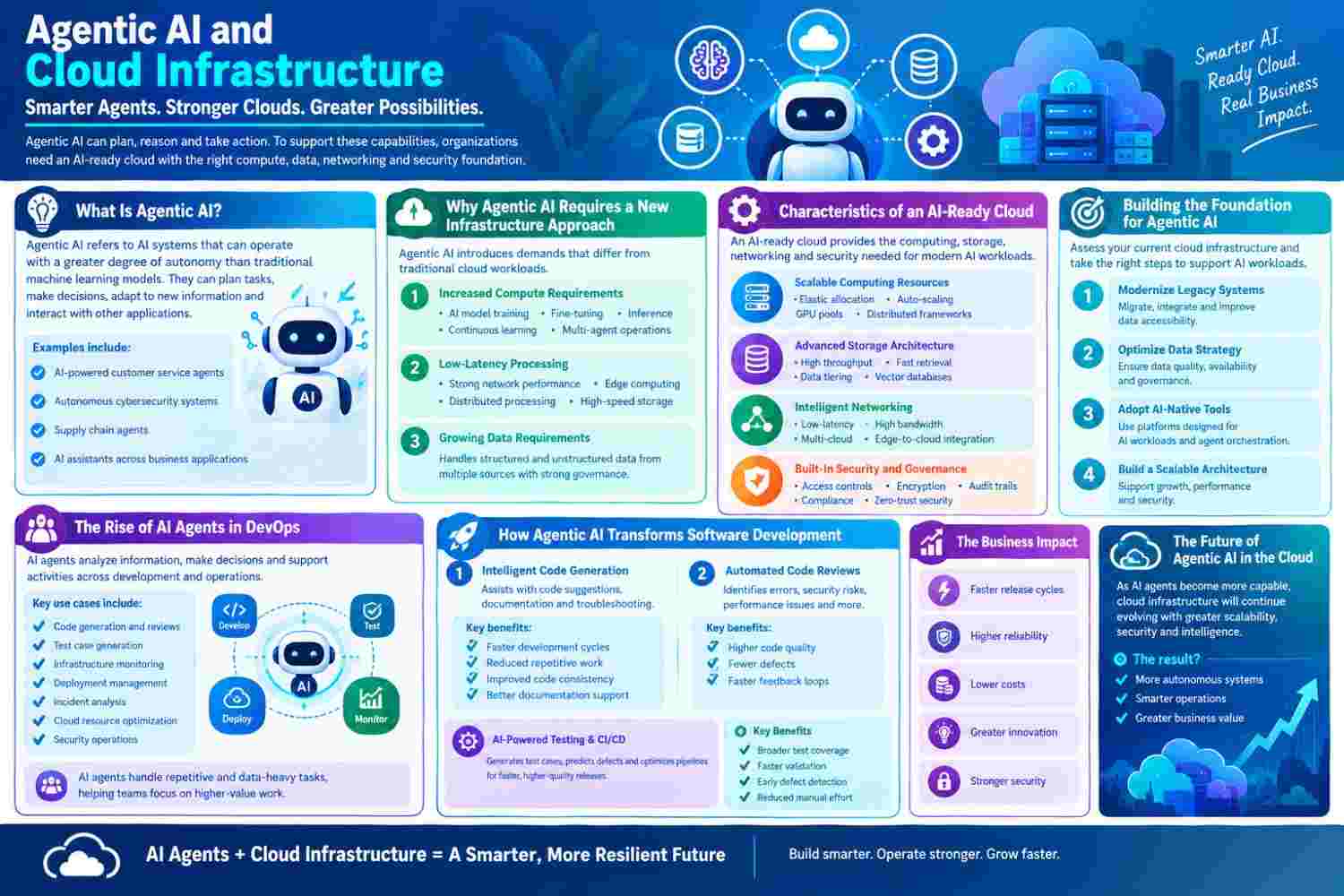
Agentic AI refers to AI systems that can operate with a greater degree of autonomy than traditional machine learning models. Rather than responding only to prompts or predefined instructions, these systems can plan tasks, make decisions, adapt to new information, and interact with other applications.
Examples include:
- AI-powered customer service agents managing support requests
- Autonomous cybersecurity systems responding to threats
- Supply chain agents handling inventory and procurement
- AI assistants coordinating activities across business applications
Unlike conventional AI tools, agentic AI often runs continuously and interacts with multiple systems at once. These requirements place added pressure on cloud infrastructure, particularly in data processing, memory, and connectivity.
Why Agentic AI Requires a New Infrastructure Approach
Many enterprise cloud infrastructure environments were built for application hosting, database management, and routine business operations. Agentic AI introduces demands that differ from traditional cloud computing workloads.
1. Increased Compute Requirements
Agentic AI systems often rely on large language models, reasoning engines, vector databases, and multimodal capabilities. Supporting these workloads requires infrastructure for:
- AI model training
- Fine-tuning
- Inference
- Continuous learning
- Multi-agent operations
As a result, GPUs, AI accelerators, and distributed computing resources have become important components of modern AI infrastructure.
2. Low-Latency Processing
In areas such as financial operations, cybersecurity, and healthcare, processing delays can affect outcomes. These environments require:
- Strong network performance
- Edge computing support
- Distributed processing
- High-speed storage
3. Growing Data Requirements
Autonomous agents depend on information from enterprise databases, CRM and ERP platforms, knowledge repositories, IoT devices, and external data sources. This increases the need for cloud infrastructure capable of handling large data volumes while supporting accessibility and governance.
Characteristics of an AI-Ready Cloud
An AI-ready cloud is built to support the computing, storage, networking, and security requirements of modern AI workloads. Several characteristics define a well-designed AI-ready cloud infrastructure.
1. Scalable Computing Resources
AI workloads can vary based on training activities, inference tasks, and user demand. A scalable cloud environment typically includes:
- Elastic compute allocation
- Auto-scaling capabilities
- GPU resource pools
- Distributed processing frameworks
These capabilities help organizations match resources with workload requirements.
2. Advanced Storage Architecture
Agentic AI applications rely on large volumes of structured and unstructured data. Cloud storage systems should support:
- High throughput
- Fast data retrieval
- Data tiering
- Vector databases and embedding stores
3. Intelligent Networking
Strong networking capabilities are essential for AI operations. Modern cloud infrastructure should provide:
- Low-latency communication
- High-bandwidth connectivity
- Multi-cloud support
- Edge-to-cloud integration
4. Built-In Security and Governance
AI agents often interact with business-critical data and systems. Key requirements include:
- Identity and access controls
- Data encryption
- Audit trails
- Compliance monitoring
- Zero-trust security frameworks
Building the Foundation for Agentic AI
Organizations preparing for agentic AI should assess whether their existing cloud infrastructure can support advanced AI workloads.
1. Modernize Legacy Systems
Many enterprises still rely on applications that were not built for AI integration. Modern Cloud Infrastructure Services can help organizations migrate workloads, improve system interoperability, and support AI adoption initiatives.
Common modernization efforts include:
- Migrating workloads to cloud-native platforms
- Replacing outdated infrastructure
- Adopting API-based integrations
- Improving data accessibility
2. Create a Unified Data Environment
Data silos can limit AI performance. A unified data strategy may include:
- Centralized data platforms
- Data lakes and lakehouses
- Metadata management standards
- Data quality monitoring
Access to connected and organized data helps AI agents work with a broader business context.
3. Deploy AI-Optimized Hardware
Building modern AI infrastructure often involves:
- GPU-enabled cloud services
- AI acceleration chips
- High-performance computing clusters
- Specialized inference systems
4. Invest in Observability
As agentic AI deployments grow, monitoring becomes increasingly important. Observability tools provide visibility into:
- Agent behavior
- Model performance
- Resource utilization
- Decision pathways
- System reliability
The Role of Hybrid and Multi-Cloud Strategies
Many organizations are adopting hybrid and multi-cloud models to support AI workloads and improve infrastructure flexibility.
Benefits of Hybrid Cloud
Hybrid cloud environments combine public cloud services with private cloud infrastructure. Key benefits include:
- Greater control over sensitive data
- Support for regulatory requirements
- Flexible workload placement
- Lower latency for critical applications
This approach allows organizations to run AI workloads in environments that align with business and operational needs.
Benefits of Multi-Cloud
Multi-cloud strategies involve using services from multiple providers. Common advantages include:
- Reduced reliance on a single vendor
- Access to specialized AI services
- Improved resilience
- Geographic flexibility
As agentic AI deployments expand, organizations may use different platforms for model training, inference, storage, and data management.
Edge Computing and Agentic AI
Not every AI task can rely solely on centralized cloud processing. In sectors such as manufacturing, healthcare, logistics, and retail, response times often influence operational outcomes.
Edge computing places processing closer to where data is generated, reducing the distance information must travel.
Key Advantages of Edge Integration
- Lower latency
- Reduced bandwidth consumption
- Faster decision-making
- Higher operational reliability
- Better user experiences
For example, manufacturing systems can use edge devices to monitor equipment and process operational data locally while sharing selected insights with the cloud. The combination of edge technologies and scalable cloud resources creates a solid foundation for agentic AI applications and modern cloud infrastructure.
Managing AI Infrastructure Costs
Building and maintaining AI infrastructure can increase operational spending, particularly for GPU usage, data storage, data transfers, model training, and inference workloads.
Resource Optimization
Organizations can reduce unnecessary costs by:
- Dynamic scaling
- Scheduled resource allocation
- Capacity planning
- Monitoring idle resources
Model Optimization
Task-specific models often require fewer resources than large, general-purpose models. Common approaches include:
- Model compression
- Quantization
- Distillation
- Efficient inference architectures
Data Management Strategies
Storage costs can also rise as data volumes grow. Useful practices include:
- Archiving inactive data
- Storage tiering
- Data lifecycle management
- Removing duplicate datasets
Challenges Organizations Must Address
While agentic AI offers new capabilities, organizations often face several obstacles during adoption.
1. Infrastructure Complexity
AI environments typically include:
- Models
- Data pipelines
- Compute clusters
- Vector databases
- Monitoring tools
Managing these technologies requires technical expertise and careful planning.
2. Data Governance Issues
AI systems rely on enterprise data, making governance a critical requirement. Key areas include:
- Data quality
- Access controls
- Regulatory compliance
- Data retention policies
3. Security Risks
Autonomous agents may interact with sensitive systems and information. Organizations should evaluate:
- Model vulnerabilities
- API security
- Data leakage risks
- Unauthorized agent actions
- Supply chain threats
4. Skills Gaps
Many businesses face shortages of professionals with expertise in AI engineering, cloud architecture, data science, MLOps, and AI governance. These gaps can affect the pace of agentic AI implementation and management of AI infrastructure.
Future Trends in AI-Ready Cloud Infrastructure
The next phase of AI-ready cloud infrastructure will focus on technologies built specifically for AI workloads.
1. AI-Native Cloud Platforms
Cloud providers are adding AI capabilities directly into their platforms, giving organizations more options for developing and deploying AI applications.
2. Specialized AI Hardware
Custom chips, GPUs, and AI accelerators are becoming increasingly important for training and inference workloads.
3. Autonomous Infrastructure Management
AI is starting to take on routine infrastructure tasks, including:
- Resource allocation
- Anomaly detection
- Workload optimization
- Performance monitoring
4. Distributed AI Ecosystems
Many agentic AI workloads now span cloud, edge, and on-premises environments. This is prompting organizations to rethink the design and management of AI infrastructure.
Conclusion
Unlike traditional AI systems that primarily generate responses or predictions, agentic AI can interact with applications, process information from multiple sources, and execute tasks across business workflows. These capabilities create new demands on cloud infrastructure and data environments.
Supporting autonomous AI workloads requires an AI-ready cloud infrastructure with scalable computing resources, modern storage architectures, reliable networking, and strong security controls. Access to connected, high-quality data is equally important for large-scale AI operations.
The ability to deploy agentic AI at scale depends on the strength of the underlying AI infrastructure. Organizations that invest in modern cloud infrastructure and data foundations will be better prepared for future AI initiatives.
FAQs
1. What is an AI-ready cloud infrastructure?
An AI-ready cloud infrastructure is a cloud environment built for AI workloads, combining scalable computing resources, advanced storage, networking, security controls, and data management capabilities required for training and deploying AI applications.
2. Why does agentic AI require scalable cloud resources?
Agentic AI often processes large datasets, interacts with multiple systems, and performs continuous inference tasks. Scalable cloud resources help accommodate changing workload requirements while maintaining application responsiveness and resource availability.
3. How is agentic AI different from traditional AI?
Traditional AI is typically designed for specific tasks such as predictions or recommendations. Agentic AI can plan actions, make decisions, adapt to new inputs, and execute multi-step workflows autonomously.
4. What role do GPUs play in AI infrastructure?
GPUs support AI infrastructure by handling large volumes of parallel computations required for model training and inference. Their processing capabilities help reduce execution times for demanding AI workloads.
5. Why is data management important for agentic AI?
Agentic AI relies on data from multiple sources to perform tasks and make decisions. Effective data management improves accessibility, quality, governance, and consistency, helping agents operate with reliable business contexts.
6. How does edge computing support agentic AI deployments?
Edge computing processes data close to where it is generated, reducing latency and network dependency. This approach supports agentic AI applications that require timely responses in operational environments.
7. What are the biggest challenges in building an AI-ready cloud?
Building an AI-ready cloud can involve challenges related to infrastructure complexity, security, governance, operational costs, data quality, and access to professionals with cloud and AI expertise.