



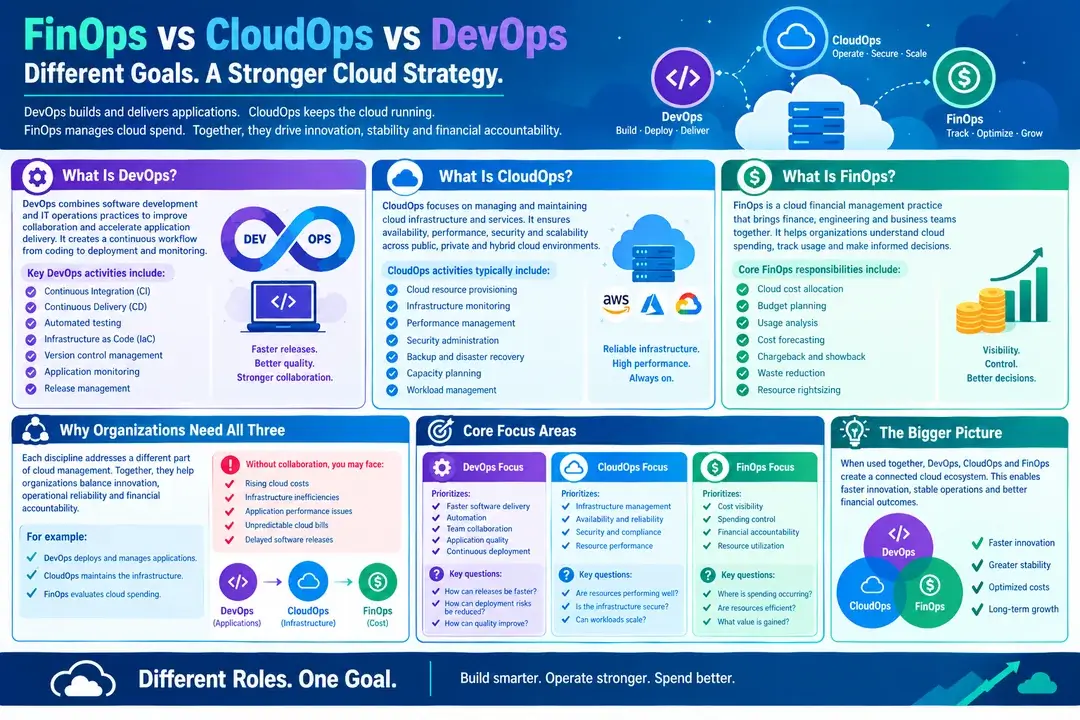
Cloud adoption has introduced new challenges in software delivery, infrastructure management, and cost control. To address these areas, organizations rely on DevOps, CloudOps, and FinOps. While they are closely connected, each serves a distinct purpose.
DevOps focuses on application development and deployment, CloudOps manages cloud infrastructure and operational performance, and FinOps helps organizations track and optimize cloud spending. Understanding FinOps vs CloudOps vs DevOps is essential for building a cloud strategy that balances innovation, operational stability, and financial accountability. This article explores their roles, differences, and how they work together in modern cloud environments.
What are DevOps, CloudOps, and FinOps?
What Is DevOps?
DevOps combines software development and IT operations practices to improve collaboration and accelerate application delivery. It creates a continuous workflow that covers coding, testing, deployment, and monitoring.
By promoting shared responsibility and automation, DevOps helps teams release updates faster while maintaining software quality. The approach reduces operational bottlenecks and supports frequent releases.
Key DevOps activities include:
- Continuous Integration (CI)
- Continuous Delivery (CD)
- Automated testing
- Infrastructure as Code (IaC)
- Version control management
- Application monitoring
- Release management
What Is CloudOps?
CloudOps, or Cloud Operations, focuses on managing and maintaining cloud infrastructure and services. As organizations expand across public, private, and hybrid cloud environments, CloudOps teams handle the operational tasks needed to keep systems available and performing efficiently.
Their responsibilities cover infrastructure monitoring, security, capacity planning, and workload management. CloudOps plays a critical role in supporting business applications and maintaining service reliability.
CloudOps activities typically include:
- Cloud resource provisioning
- Infrastructure monitoring
- Performance management
- Security administration
- Backup and disaster recovery
- Capacity planning
- Workload management
What Is FinOps?
FinOps, short for Financial Operations, is a cloud financial management practice that brings finance, engineering, and business teams together. It helps organizations understand cloud spending, track resource usage, and make informed budget decisions.
As cloud costs are based on consumption, FinOps provides greater visibility into spending patterns and resource allocation. The discipline focuses on balancing business value with financial accountability.
Core FinOps responsibilities include:
- Cloud cost allocation
- Budget planning
- Usage analysis
- Cost forecasting
- Chargeback and showback
- Waste reduction
- Resource rightsizing
Why Organizations Need All Three
Many organizations treat DevOps, CloudOps, and FinOps as separate functions. In reality, cloud environments require all three to work together. Each discipline addresses a different aspect of cloud management, from application delivery to infrastructure operations and cost control.
For example:
- DevOps deploys and manages application releases.
- CloudOps maintains the infrastructure supporting those applications.
- FinOps evaluates cloud spending and resource usage.
Without collaboration, organizations may face:
- Rising cloud costs
- Infrastructure inefficiencies
- Application performance issues
- Unpredictable cloud bills
- Delayed software releases
Together, these frameworks help organizations balance innovation, operational reliability, and financial accountability.
FinOps vs CloudOps vs DevOps: Core Focus Areas
Understanding FinOps vs CloudOps vs DevOps becomes easier when comparing their primary objectives. While all three contribute to cloud success, their priorities differ.
DevOps Focus
DevOps prioritizes:
- Faster software delivery
- Automation
- Team collaboration
- Application quality
- Continuous deployment
Key questions:
- How can releases happen faster?
- How can deployment risks be reduced?
- How can software quality improve?
CloudOps Focus
CloudOps prioritizes:
- Cloud infrastructure management
- Availability and reliability
- Security and compliance
- Resource performance
Key questions:
- Are cloud resources performing effectively?
- Is the infrastructure secure?
- Can workloads scale as needed?
FinOps Focus
FinOps prioritizes:
- Cost visibility
- Cloud spending control
- Financial accountability
- Resource utilization
Key questions:
Where is cloud spending occurring?
Are resources being used efficiently?
What value is the organization gaining from cloud investments?
Cloud Operations Comparison: FinOps vs CloudOps vs DevOps
A practical way to understand FinOps vs CloudOps vs DevOps is to compare their objectives, stakeholders, success metrics, and tools.
1. Primary Objective
- DevOps: Accelerate software development and application delivery.
- CloudOps: Manage cloud infrastructure and operational performance.
- FinOps: Monitor, manage, and optimize cloud spending.
2. Key Stakeholders
DevOps Teams
- Developers
- QA engineers
- Operations engineers
CloudOps Teams
- Cloud architects
- Infrastructure engineers
- Security professionals
FinOps Teams
- Finance teams
- Engineering leaders
- Cloud cost analysts
3. Success Metrics
- DevOps: Deployment frequency, lead time
- CloudOps: Uptime, availability, response times
- FinOps: Cost efficiency, budget accuracy, resource utilization
4. Common Tools
- DevOps: Jenkins, GitHub Actions, Docker, Kubernetes
- CloudOps: AWS CloudWatch, Azure Monitor, Terraform
- FinOps: CloudHealth, AWS Cost Explorer, Finout
How DevOps, CloudOps, and FinOps Work Together
The most successful organizations do not isolate these practices. Instead, they create collaboration among all three.
Example: Launching a New Application
Step 1: DevOps Builds and Deploys
The DevOps team creates application code, tests it, and releases updates using CI/CD pipelines. Their focus is speed, quality, and automation.
Step 2: CloudOps Supports Infrastructure
CloudOps provisions cloud resources such as:
- Virtual machines
- Containers
- Storage services
- Networking components
The team monitors system health and uptime.
Step 3: FinOps Evaluates Spending
FinOps reviews:
- Infrastructure costs
- Resource utilization
- Cost trends
- Budget impact
The Rise of FinOps in Cloud-First Organizations
As cloud usage grows, organizations are paying closer attention to cloud costs. Many companies once focused primarily on DevOps and CloudOps, with spending reviews taking place only after monthly invoices arrived. The growing importance of FinOps is driven by several factors:
Growing Cloud Complexity
- Multi-cloud environments
- Hybrid infrastructure
- Expanding cloud services
- Dynamic workloads
Usage-Based Pricing
- Compute resources
- Storage consumption
- Network traffic
- Database usage
Demand for Accountability
- Department spending visibility
- Project-level cost tracking
- Application profitability insights
- Resource utilization analysis
Common Areas of Overlap
While DevOps, CloudOps, and FinOps have different goals, they share several operational practices.
Automation
- Automated deployments in DevOps
- Automated provisioning in CloudOps
- Automated cost reporting in FinOps
Data-Driven Decisions
Teams rely on:
- Dashboards
- Reports
- Monitoring tools
- Analytics platforms
Shared Responsibility
- CloudOps identifies underused resources
- FinOps measures cost impact
- DevOps improves application efficiency
Challenges Organizations Face
Implementing DevOps, CloudOps, and FinOps often comes with operational and organizational challenges.
Common challenges include
- Siloed teams
Limited communication can increase costs and reduce visibility. - Lack of cost awareness
Development teams may prioritize performance without considering cloud spending. - Skills gaps
Finding expertise in cloud architecture, automation, and financial management can be difficult. - Fragmented toolsets
Using separate tools for monitoring, deployment, and cost tracking can create reporting inconsistencies.
Best Practices for Integrating FinOps, CloudOps, and DevOps
- Establish shared goals focused on performance, reliability, and cost efficiency.
- Improve cost visibility by giving engineering teams access to cloud spending data.
- Use resource tagging to track applications, departments, projects, and environments.
- Review cloud resources regularly to identify utilization, performance, and budget concerns.
- Build cross-functional teams that include engineering, operations, finance, and security stakeholders.
- Which Approach Is Most Important?
There is no single answer to this question because each discipline addresses a different business need. Strong DevOps practices can improve software delivery, but weak CloudOps capabilities may affect infrastructure performance. Similarly, effective CloudOps without FinOps can lead to rising cloud costs and limited spending visibility.
Organizations that gain the most value from the cloud combine:
- DevOps for faster application delivery
- CloudOps for infrastructure reliability and performance
- FinOps for cost management and financial accountability
Conclusion
The discussion around FinOps vs CloudOps vs DevOps is not about selecting one approach over another. Each discipline plays a distinct role in cloud operations. DevOps focuses on application development and delivery, CloudOps manages cloud infrastructure and performance, and FinOps provides visibility into cloud spending and resource usage.
As organizations expand their cloud footprint, collaboration across these functions becomes increasingly important. Combining DevOps, CloudOps, and FinOps helps businesses balance innovation, operational reliability, and cost management while gaining greater value from their cloud investments.
Frequently Asked Questions (FAQs)
1. What is the main difference between FinOps, CloudOps, and DevOps?
DevOps focuses on application development and deployment, CloudOps manages cloud infrastructure and operational performance, while FinOps tracks, allocates, and optimizes cloud spending to improve financial accountability and resource utilization.
2. Can an organization implement FinOps without CloudOps?
Yes, organizations can adopt FinOps independently. However, cloud cost analysis becomes more effective when combined with CloudOps, which provides visibility into infrastructure usage, performance trends, and resource allocation.
3. How does DevOps support FinOps initiatives?
DevOps supports FinOps by improving application efficiency, automating deployments, reducing unnecessary resource consumption, and providing operational insights that help teams identify and manage cloud spending patterns.
4. Why has FinOps become important in cloud environments?
Cloud services follow usage-based pricing models, making costs difficult to predict. FinOps helps organizations monitor spending, allocate budgets accurately, identify waste, and improve cloud investment decisions across teams.
5. Do DevOps and CloudOps perform similar tasks?
While they share some responsibilities, DevOps focuses on software delivery, automation, and application development, whereas CloudOps concentrates on infrastructure management, system reliability, performance monitoring, security, and scalability.
6. What tools are commonly used in FinOps?
Common FinOps tools include AWS Cost Explorer, Azure Cost Management, CloudHealth, Apptio Cloudability, Finout, and other platforms that support cost tracking, budgeting, reporting, forecasting, and optimization efforts.
7. How do FinOps, CloudOps, and DevOps work together?
DevOps delivers applications, CloudOps manages the supporting infrastructure, and FinOps monitors cloud spending. Together, they help organizations balance application performance, operational reliability, financial visibility, and resource efficiency.