


Introduction: AI Is Reshaping Enterprise eCommerce
Finding the right product, setting competitive prices, managing inventory, and delivering personalized experiences are no longer independent ecommerce functions. Businesses are adopting AI in ecommerce as part of their broader ecommerce development solutions strategy.
What started with basic recommendations has expanded into capabilities that support product discovery, personalization, pricing, inventory management, merchandising, and customer service. As a result, AI-powered ecommerce is helping enterprises make faster decisions, improve operational efficiency, and deliver more relevant shopping experiences.
AI is no longer limited to chatbots or recommendation engines. It now plays a role across multiple areas of commerce operations. This article explores seven practical AI use cases that are helping enterprise ecommerce organizations improve revenue, customer engagement, and business performance.
1. AI-Powered Product Search and Discovery
Finding the right product quickly can have a direct impact on conversions. Traditional search functions often rely on exact keyword matches, making it difficult to understand customer intent when shoppers use detailed or conversational queries.
Semantic Search and Search Intent
Modern AI ecommerce search tools use semantic search and natural language processing to interpret search intent more accurately. Instead of looking only for matching keywords, these systems evaluate context and meaning. For example, a customer searching for a “lightweight laptop for remote work” can receive relevant product suggestions even if those exact words do not appear in product descriptions.
Personalized Product Discovery
AI-powered product discovery uses browsing behavior, purchase history, product preferences, and session activity to present relevant products. This approach helps customers navigate large catalogs more efficiently and supports more personalized search results. It also reduces the effort required to find suitable products.
Impact on Conversions and Customer Experience
As part of ecommerce web development and ecommerce platform development initiatives, intelligent product search can improve product visibility and reduce search friction. When customers find relevant products faster, they are more likely to continue browsing, add items to their carts, and complete purchases. Better discovery also contributes to a more satisfying shopping experience.
2. Real-Time Personalization and Product Recommendations
Modern buyers expect relevant experiences throughout their shopping journey. Generic promotions and static recommendations often fail to capture attention, making personalization an important capability for ecommerce businesses.
Understanding Customer Preferences
AI personalization ecommerce solutions analyze multiple customer signals, including:
- Browsing behavior
- Purchase history
- Product interactions
- Cart activity
- Shopping patterns
These insights help businesses present products that align with individual interests, creating a more personalized ecommerce experience.
Cross-Selling and Upselling Opportunities
Using AI product recommendations, ecommerce platforms can identify products that customers are more likely to purchase alongside or instead of their original selection. Recommendations may include:
- Related accessories
- Premium product alternatives
- Frequently purchased combinations
- Similar products within a category
This approach helps increase product discovery while supporting cross-selling and upselling efforts.
Personalized Offers and Business Impact
Ecommerce personalization also enables targeted offers based on factors such as:
- Customer loyalty
- Buying frequency
- Purchase patterns
- Seasonal preferences
As part of broader ecommerce development services, personalization can improve customer engagement, increase conversion rates, encourage repeat purchases, and contribute to revenue growth.
3. Conversational Commerce and AI Shopping Assistants
Conversational commerce is changing how customers interact with online stores. Unlike a traditional ecommerce AI chatbot, modern AI assistants can understand context, answer detailed questions, and help shoppers navigate the buying journey.
AI Assistants Beyond Traditional Chatbots
An AI shopping assistant can engage in natural conversations rather than following predefined responses. Customers can ask questions, refine searches, and receive guidance based on their needs, preferences, and shopping goals.
Product Discovery and Recommendations
In conversational ecommerce, customers can discover products through conversation rather than navigating multiple pages. AI assistants can support shoppers by providing:
- Product recommendations
- Product comparisons
- Pricing information
- Availability updates
- Answers to customer questions
Connected Commerce Experiences
The value of AI ecommerce solutions increases when assistants are connected to product catalogs, pricing data, inventory systems, and order information. Access to real-time business data allows AI assistants to deliver more relevant responses while supporting customer engagement and conversion.
4. Predictive Demand Forecasting and Inventory Optimization
Managing inventory effectively remains a challenge for many ecommerce businesses. Excess stock increases holding costs, while product shortages can lead to missed sales opportunities and dissatisfied customers.
Predicting Customer Demand
AI demand forecasting models analyze multiple data points to identify future demand patterns, including:
- Historical sales data
- Seasonal trends
- Promotional activity
- Regional demand
- Customer purchasing behavior
These insights support more accurate ecommerce demand forecasting and help businesses prepare for changes in demand.
Optimizing Inventory Planning
AI inventory management tools help organizations make better inventory decisions by identifying fast-moving products, replenishment needs, and slow-selling items. This allows teams to respond more effectively to changing demand conditions.
Improving Operational Efficiency
Using predictive ecommerce analytics and ecommerce automation, businesses can:
- Reduce stockouts
- Minimize overstock situations
- Improve warehouse planning
- Support purchasing decisions
Better inventory planning contributes to operational efficiency while helping maintain product availability and customer satisfaction.
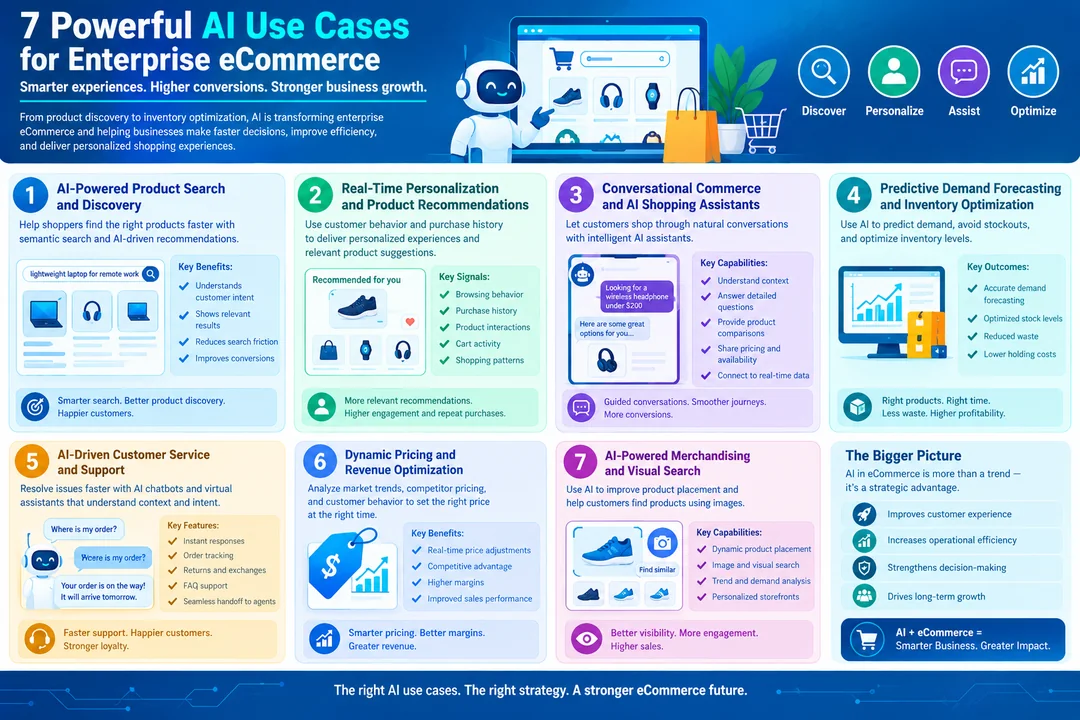
5. AI-Driven Pricing and Promotion Optimization
Pricing plays a major role in both revenue growth and profitability. Rather than relying solely on manual analysis, businesses are using AI to support faster and better pricing decisions.
Demand-Based and Dynamic Pricing
AI pricing ecommerce tools evaluate multiple factors to recommend pricing adjustments, including:
- Customer demand
- Inventory levels
- Competitor and market signals
- Product performance
- Buying patterns
This approach supports dynamic pricing ecommerce strategies that can respond to changing market conditions.
Personalized Promotions and Discounts
Not all customers respond to the same promotional offers. AI-driven promotions can help businesses deliver targeted discounts based on customer behavior, loyalty, purchase history, and cart activity. This allows promotional budgets to be used more effectively.
Revenue and Margin Optimization
As part of ecommerce pricing optimization, AI can recommend inventory-aware pricing, product bundles, and discount levels that align with inventory goals. These insights support ecommerce revenue optimization by balancing sales growth, inventory movement, and profit margins.
6. Automated Customer Service and Order Management
Customer support teams often spend considerable time handling routine inquiries. AI customer service ecommerce solutions help manage everyday requests, allowing support teams to focus on issues that require human attention.
Customer Support Automation
AI-powered customer support tools can assist customers with:
- Order-status queries
- Shipping updates
- Returns and refunds
- Frequently asked questions
- Account-related requests
This allows customers to access information quickly without waiting for support agents.
AI in Order Management
AI order management capabilities can automate order-related communication throughout the buying process. This includes order confirmations, delivery notifications, return updates, and service requests. Faster communication helps customers stay informed about their purchases.
Maintaining a Positive Customer Experience
By combining ecommerce automation with support operations, businesses can reduce repetitive workloads, improve response times, and enhance the overall ecommerce customer experience. The result is more efficient support operations while maintaining service quality and customer satisfaction.
7. AI-Powered Merchandising and Revenue Optimization
Product visibility can have a direct impact on customer engagement and sales, making merchandising an important function within enterprise ecommerce. AI ecommerce merchandising tools help businesses make data-driven merchandising decisions that support customer engagement and business performance.
Product Assortment and Placement
AI merchandising solutions analyze a range of factors to support product assortment and placement decisions, including:
- Customer demand
- Product performance
- Inventory availability
- Sales trends
- Category profitability
These insights help determine which products should receive greater visibility across ecommerce channels.
Identifying Revenue Opportunities
AI can uncover patterns related to:
- High-performing products
- Cross-selling opportunities
- Emerging buying trends
- Customer preferences
By combining customer and sales insights, businesses can identify new opportunities to improve product visibility and category performance.
Supporting Revenue-Focused Decisions
Within an enterprise ecommerce platform, merchandising insights can help prioritize products, refine category strategies, and support ecommerce revenue optimization goals. As part of an intelligent ecommerce strategy, AI helps teams make better decisions based on customer behavior and sales performance.
What Enterprises Need to Implement AI in eCommerce
Successful AI adoption requires the right mix of data, technology, architecture, and governance. Without these foundations, AI initiatives can struggle to deliver real business value.
Unified Data
AI relies on connected and accurate information. Ecommerce data integration brings together customer data, product data, inventory, and transaction records within a strong ecommerce data architecture, providing the data foundation needed for AI applications.
Integrated Technology Stack
AI performs best when key business systems work together. Common ecommerce integrations include:
- ERP integration
- CRM integration
- PIM integration
- OMS integration
These connections support a more complete view of customers and operations.
Scalable Architecture
Organizations investing in enterprise ecommerce development, ecommerce software development, or custom ecommerce development should consider:
- API-first ecommerce
- Headless ecommerce development
- Composable commerce
These approaches provide flexibility for future AI capabilities and support ecommerce web application development requirements.
Security and AI Governance
Strong AI governance, ecommerce security, data privacy, and enterprise AI security practices help organizations manage risk while supporting responsible AI adoption.
How Enterprises Can Start Their AI eCommerce Journey
Many businesses view AI as a large-scale transformation project, but adoption often begins with targeted initiatives that address specific business challenges. A practical AI ecommerce strategy focuses on measurable outcomes and gradual implementation.
1. Assess Current Capabilities
Start by evaluating existing ecommerce platforms, data quality, integrations, and operational challenges. This helps identify areas where ecommerce AI implementation can deliver the most value.
2. Identify High-Value Use Cases
Focus on use cases with clear business impact, such as:
- Product recommendations
- Search optimization
- Demand forecasting
- Customer support automation
3. Prepare Data and Launch a Pilot
Successful enterprise AI implementation depends on reliable and connected data. After preparing the required data sources, launch a focused pilot with defined success metrics.
4. Measure Results and Scale
Track business outcomes, refine the approach, and expand successful initiatives across the organization. Many businesses also partner with an ecommerce development company to support implementation and select the right ecommerce development solution for long-term growth.
Conclusion: AI Is Becoming a Core eCommerce Capability
AI-powered ecommerce is no longer limited to product recommendations or customer support. It is becoming part of how enterprises manage search, personalization, pricing, inventory, merchandising, and service operations.
For organizations pursuing enterprise ecommerce development, the value of AI comes from solving practical business challenges and improving performance across commerce functions. A strong foundation of data, integrations, and scalable architecture helps support these capabilities.
As businesses invest in ecommerce development solutions, intelligent features are becoming a standard component of modern commerce platforms. Combined with the right ecommerce development services, AI can help enterprises make better use of data, improve customer experiences, and support business growth.
Frequently Asked Questions
What is an AI-ready ecommerce platform?
An AI-ready ecommerce platform is built to support AI-driven capabilities by combining connected customer, product, and operational data with flexible integrations, scalable infrastructure, and tools for personalization, automation, analytics, and decision-making.
What technologies are needed to build an AI-ready ecommerce platform?
Building an AI-ready ecommerce platform typically requires cloud infrastructure, APIs, CRM, ERP, PIM, OMS, analytics tools, customer data platforms, and machine learning models that work together across commerce operations.
How can AI improve enterprise ecommerce?
AI can improve enterprise ecommerce by enhancing product search, personalizing shopping experiences, optimizing inventory planning, supporting pricing strategies, automating customer service, and providing insights that inform merchandising and business decisions.
How should businesses start implementing AI in ecommerce?
Businesses should begin by evaluating existing ecommerce capabilities, identifying high-value use cases, preparing and connecting data sources, launching a focused pilot project, tracking results, and expanding successful initiatives over time.