


Marketing teams collect customer data from almost every interaction. Website visits, email engagement, mobile app activity, purchases, loyalty programs, customer service conversations, and social media interactions all generate valuable information.
In many organizations, customer information is scattered across multiple systems. The CRM stores sales interactions, the email platform tracks campaign engagement, and support tools record service requests. Each system captures part of the customer journey, but none provides a complete view.
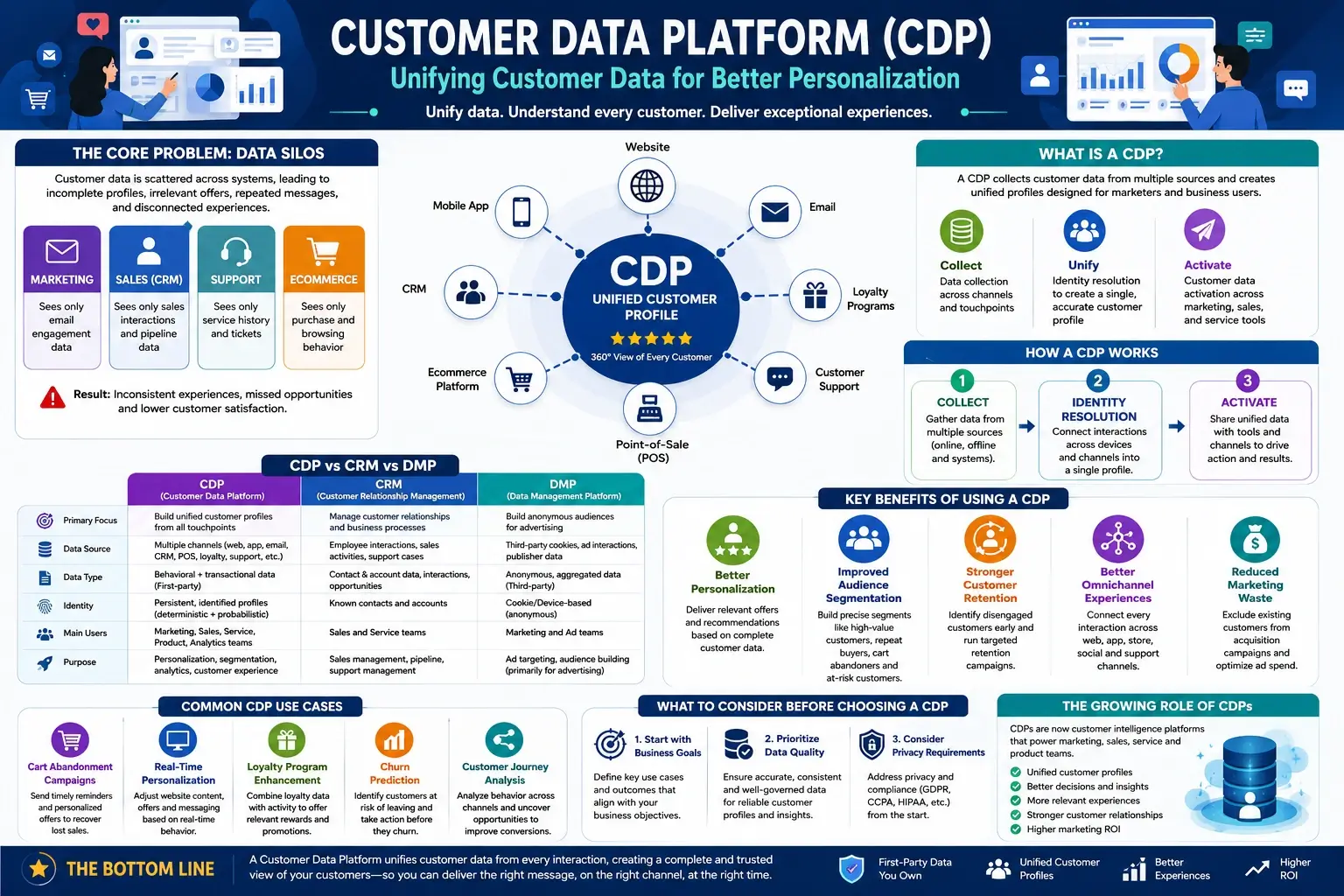
This often results in irrelevant offers, repeated messages, and disconnected customer experiences. A Customer Data Platform (CDP) brings data from different sources into a single customer profile. By unifying customer data, CDPs help businesses improve personalization, audience segmentation, retention, and overall customer experience.
The Core Problem a CDP Solves
Data Silos Create Business Problems
When customer data is spread across multiple systems, teams work with incomplete information.
For example:
- Marketing teams may only see email engagement data.
- Sales teams may only see CRM interactions.
- Customer support teams may only see service history.
- Ecommerce teams may only see purchase behavior.
Without a unified view, customer experiences become inconsistent. A customer who recently made a purchase may continue seeing acquisition ads, while another may have to repeat information already shared with the company. These disconnected interactions can affect both customer satisfaction and campaign performance.
Why Data Fragmentation Matters More Today
The importance of unified customer data has grown as businesses rely more on first-party data. As third-party cookies become less effective, brands increasingly depend on information collected directly from customers.
At the same time, marketing tools rely on accurate data to deliver useful insights and targeting. Duplicate, incomplete, or disconnected records can reduce campaign effectiveness and limit customer understanding.
A Customer Data Platform (CDP) helps address this challenge by bringing customer data together and creating a more reliable customer view.
What Is a Customer Data Platform?
A Customer Data Platform (CDP) is software that collects customer data from multiple sources and combines it into a unified customer profile. Unlike traditional databases, a CDP is designed for marketers and business users.
A true CDP is built on three core capabilities:
- Data collection across channels
- Identity resolution
- Customer data activation
How a CDP Works
1. Collecting Customer Data
A CDP gathers customer data from multiple sources, including:
- Websites
- Mobile apps
- CRMs
- Ecommerce platforms
- Email marketing tools
- Loyalty programs
- Point-of-sale systems
- Customer support platforms
By bringing information from different channels together, a CDP creates a more complete customer profile.
2. Identity Resolution
Identity resolution connects customer interactions across devices and channels into a single profile.
For example, a customer may:
- Browse products on a laptop
- Open emails on a smartphone
- Make a purchase in-store
- Contact support through chat
CDPs typically use two methods:
- Deterministic matching: Uses verified identifiers such as email addresses, customer IDs, and loyalty numbers.
- Probabilistic matching: Uses signals such as devices, locations, and browsing behavior when direct identifiers are unavailable.
3. Activating Customer Data
A CDP shares customer data with downstream systems, including:
- Email marketing platforms
- Advertising networks
- Personalization tools
- Customer service systems
- Analytics platforms
CDP vs CRM: What’s the Difference?
A common misconception is that a CRM and a CDP serve the same purpose.
What a CRM Does
A Customer Relationship Management (CRM) platform helps sales and service teams manage customer relationships. It is used to:
- Track leads
- Manage opportunities
- Record interactions
- Handle support cases
Most CRM data comes from employee interactions and business processes.
What a CDP Does
A Customer Data Platform (CDP) collects behavioral and transactional data from multiple customer touchpoints, including:
- Browsing activity
- Purchase history
- Email engagement
- Loyalty program activity
A CDP creates unified customer profiles and provides insights that can complement and enrich CRM data.
CDP vs DMP: Understanding the Difference
Another technology often compared with a CDP is the Data Management Platform (DMP).
What a DMP Was Built For
DMPs were designed mainly for advertising. They used anonymous third-party cookie data to create audience segments for ad targeting.
Why CDPs Have Become More Important
CDPs are built around first-party customer data. They create persistent customer profiles and support marketing, sales, and service activities across channels.
As third-party cookies have become less useful, businesses have increasingly relied on CDPs to organize and activate customer data.
Key Benefits of Using a CDP
1. Better Personalization
Customers expect relevant experiences across channels. A CDP combines customer data into a unified profile, helping marketing teams deliver recommendations based on:
- Purchase history
- Browsing behavior
- Loyalty activity
- Service interactions
2. Improved Audience Segmentation
With access to complete customer data, marketers can build more targeted audiences, such as:
- High-value customers
- Repeat buyers
- Cart abandoners
- At-risk customers
This often leads to better campaign performance.
3. Stronger Customer Retention
CDPs help identify customers showing signs of disengagement. Businesses can use these insights to run targeted retention campaigns before customers leave.
4. Better Omnichannel Experiences
Customers interact with brands through websites, apps, social media, stores, and support channels. A CDP connects these interactions into a single customer journey.
5. Reduced Marketing Waste
CDPs help businesses exclude existing customers from acquisition campaigns, reducing unnecessary ad spend and improving customer experience.
Common CDP Use Cases
Organizations use CDPs to support a variety of customer-focused initiatives.
Common Applications
- Real-Time Personalization: Adjust website content, offers, and messaging based on recent customer behavior.
- Cart Abandonment Campaigns: Send reminders to customers who leave products in their shopping carts.
- Loyalty Program Enhancement: Combine loyalty data with customer activity to deliver more relevant rewards and promotions.
- Churn Prediction: Identify customers at risk of leaving and take action before they disengage.
- Customer Journey Analysis: Understand how customers interact across channels and uncover opportunities to improve conversion rates.
What to Consider Before Choosing a CDP
1. Start with Business Goals
Define your main use cases before evaluating vendors. Ecommerce brands may focus on personalization, B2B companies on sales intelligence, and subscription businesses on retention.
2. Prioritize Data Quality
A CDP is only as effective as the data it receives. Consistent tracking standards and governance practices help create reliable customer profiles.
3. Consider Privacy Requirements
Compliance should be part of the planning process. Depending on the business, regulations such as GDPR, CCPA, and HIPAA may affect how customer data is collected, stored, and managed.
The Growing Role of CDPs
CDPs are no longer viewed solely as marketing tools. Many organizations use them as customer intelligence platforms that support marketing, sales, customer service, and product teams.
A unified customer profile helps businesses create more relevant customer experiences, improve decision-making, and gain deeper customer insights across channels.
As reliance on first-party data continues to grow, connected customer data has become increasingly important. For many organizations, a Customer Data Platform is no longer an optional addition to the technology stack. It is the foundation for understanding customers and delivering consistent experiences across every touchpoint.
FAQs
1. What is the primary purpose of a Customer Data Platform?
A Customer Data Platform brings customer data from multiple sources into a single profile, helping businesses gain a complete view of customers for better marketing and engagement.
2. How is a CDP different from a CRM?
A CRM focuses on managing customer relationships and sales activities, while a CDP collects and unifies customer data from various channels to create comprehensive profiles.
3. Can small businesses benefit from a CDP?
Yes. Small businesses can use a CDP to centralize customer data, improve audience targeting, and deliver more relevant communications without relying on multiple disconnected systems.
4. What types of data does a CDP collect?
A CDP collects data from websites, mobile apps, email campaigns, CRM systems, loyalty programs, support platforms, and purchase records to build unified customer profiles.
5. Why is identity resolution important in a CDP?
Identity resolution links customer interactions across devices and channels, helping businesses recognize the same individual and create accurate, unified customer profiles.
6. Are CDPs useful for customer retention?
Yes. CDPs help identify customers showing signs of disengagement, allowing businesses to launch retention campaigns and personalized outreach before customers leave.
7. What should companies consider before implementing a CDP?
Companies should define use cases, assess data quality, review integration requirements, and address privacy regulations to support successful CDP implementation and adoption.