


Introduction
Digital payments have become the backbone of modern commerce. From instant bank transfers and digital wallets to subscription billing and embedded finance, payment ecosystems now support billions of transactions every day. While this growth has created convenience and speed, it has also expanded opportunities for fraudsters.
Cybercriminals are becoming more organized, leveraging automation, stolen credentials, synthetic identities, and sophisticated social engineering techniques to exploit weaknesses across payment channels. As payment fraud becomes more sophisticated, businesses are adopting real-time detection, behavioral analytics, machine learning, and identity verification technologies to identify threats quickly and reduce financial losses.
The New Reality of Payment Fraud
Fraud has become more complex as payment channels continue to diversify. Criminals no longer focus on a single attack method. Instead, they combine multiple techniques to bypass security controls and exploit user behavior.
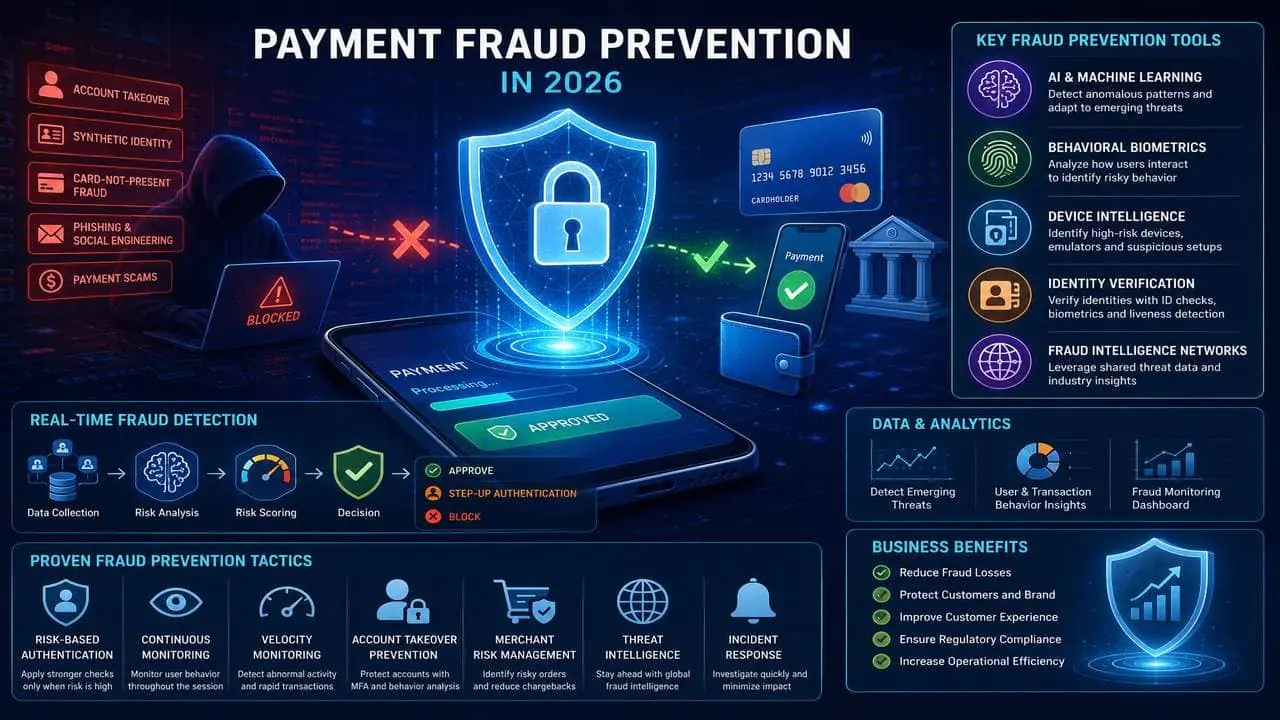
Some of the most common payment fraud threats in 2026 include:
- Account takeover fraud
- Synthetic identity fraud
- Business email compromise
- Authorized push payment fraud
- Card-not-present fraud
- Digital wallet abuse
- First-party fraud
- Merchant fraud
- Refund and chargeback fraud
The rise of real-time payment networks has amplified risk. Once fraudulent funds are transferred, recovering them can be difficult. Unlike traditional payment systems that offer processing delays, instant payment infrastructures leave little room for manual intervention. As a result, organizations must detect and respond to fraud within seconds.
The Limits of Traditional Fraud Detection
Legacy fraud detection systems were primarily built around static rules such as:
- Transactions over a specific value
- Multiple transactions within a defined period
- Payments from unfamiliar locations
- Sudden spending increases
While these rules remain useful, they struggle against modern fraud schemes. Fraudsters continuously adapt their methods, learning how to remain below predefined thresholds. A transaction may seem normal based on standard fraud rules, but unusual user behavior could indicate fraudulent activity.
For example, a customer may use the same device, location, and payment amount as usual. However, subtle indicators such as typing behavior, navigation patterns, transaction timing, and account activity could reveal unauthorized access.
The Rise of Real-Time Fraud Detection
Real-time fraud detection has become a core component of payment security in 2026. Rather than reviewing transactions after processing, modern systems evaluate risk during the transaction itself. These platforms gather data from multiple sources and generate a risk score within milliseconds.
How Real-Time Detection Works
Real-time fraud detection platforms typically collect information from:
- User behavior
- Device characteristics
- Transaction attributes
- Network intelligence
- Historical account activity
- Geolocation data
- Third-party fraud databases
Machine learning models analyze these signals simultaneously and determine whether a transaction should proceed, require additional verification, or be blocked entirely.
Key Tools Used for Payment Fraud Prevention in 2026
Enterprises are increasingly adopting integrated fraud prevention ecosystems rather than relying on isolated solutions.
1. AI-Powered Fraud Detection Platforms
Artificial intelligence has become one of the most valuable technologies for combating payment fraud. Unlike static systems, AI-based platforms continuously learn from transaction patterns and emerging threat behaviors.
Benefits include:
- Dynamic risk scoring
- Adaptive threat detection
- Reduced false positives
- Faster response times
- Pattern recognition across large datasets
Machine learning models can identify complex fraud scenarios that human analysts or traditional rules would likely miss.
2. Behavioral Biometrics
Behavioral biometrics focus on how users interact with digital systems rather than what credentials they provide.
These systems examine:
- Typing speed
- Mouse movements
- Touchscreen interactions
- Device handling patterns
- Navigation behavior
Every user develops unique behavioral characteristics over time. Deviations from these patterns may indicate account compromise or fraudulent activity.
Behavioral biometrics have gained popularity because they operate passively without disrupting customer experiences.
3. Device Intelligence Solutions
Device intelligence tools collect information about the hardware and software being used during transactions.
Common indicators include:
- Device identifiers
- Browser configurations
- Operating system details
- Network settings
- Emulator detection
- Rooted or jailbroken devices
Fraudsters frequently use virtual machines, device emulators, and automated scripts. Device intelligence solutions help security teams identify and block these activities before transactions are completed.
4. Identity Verification Platforms
Strong identity verification remains critical for fraud prevention.
Modern solutions combine several verification methods, including:
- Government ID validation
- Facial recognition
- Liveness detection
- Document authentication
- Database verification
These capabilities are particularly valuable during account registration and high-risk transactions. Identity verification helps reduce synthetic identity fraud and account creation abuse.
5. Fraud Intelligence Networks
Fraud intelligence networks aggregate threat information from numerous companies.
If a device, account, email address, IP address, or payment credential has been linked to fraudulent activity elsewhere, participating companies can use that intelligence to strengthen their own defenses.
This shared visibility creates a collaborative approach to fraud prevention and improves detection accuracy across industries.
Payment Fraud Prevention Tactics That Deliver Results
1. Risk-Based Authentication
Risk-based authentication evaluates the context of each transaction before determining the required level of verification. For low-risk activities, customers may proceed without interruption.
For higher-risk transactions, financial institutions may request:
- One-time passwords
- Biometric verification
- Multi-factor authentication
- Additional identity validation
2. Continuous User Monitoring
Authentication should not end after login. Continuous monitoring evaluates user behavior throughout an entire session.
Indicators may include:
- Sudden location changes
- Unusual account activity
- Behavioral inconsistencies
- Abnormal transaction requests
3. Velocity Monitoring
Velocity monitoring tracks how frequently activities occur within a specified period.
Examples include:
- Multiple payment attempts
- Repeated authentication failures
- Rapid account changes
- Unusual spending activity
4. Account Takeover Prevention
Account takeover remains a major fraud concern. Criminals obtain credentials through phishing campaigns, malware infections, credential leaks, and social engineering attacks.
Organizations are strengthening account protection through:
- Behavioral analytics
- Multi-factor authentication
- Device trust scoring
- Passwordless authentication
- Session monitoring
5. Merchant Risk Management
Online merchants face growing exposure to payment abuse.
Fraud mitigation strategies include:
- Customer identity verification
- Transaction risk scoring
- Chargeback monitoring
- Digital footprint analysis
- Suspicious order identification
The Growing Importance of Payment Data Analytics
Data analytics plays a central role in modern fraud prevention strategies.
Every transaction creates a valuable collection of behavioral and transactional data points. When analyzed effectively, these insights reveal emerging fraud trends and hidden risk patterns.
Key Analytics Applications
Enterprises use analytics to:
- Identify fraud hotspots
- Detect emerging attack methods
- Evaluate fraud losses
- Improve risk models
- Monitor operational performance
Advanced analytics platforms can process millions of transactions and discover relationships that would be difficult to identify manually. The growing availability of real-time analytics has transformed fraud prevention from a reactive discipline into a proactive one.
Generative AI: A Tool for Both Attackers and Defenders
Generative AI has introduced both opportunities and challenges for payment security teams.
Fraud Risks Associated with Generative AI
Threat actors are using AI capabilities to:
- Generate realistic phishing emails
- Create fake documents
- Produce synthetic identities
- Automate fraud operations
- Mimic customer communication patterns
These capabilities have increased the scale and sophistication of fraud attacks.
AI as a Defensive Technology
Security teams are also using AI to:
- Investigate suspicious transactions
- Summarize fraud cases
- Detect behavioral anomalies
- Identify hidden relationships
- Support fraud analysts
AI-assisted investigations reduce response times and help analysts focus on high-risk incidents.
Industry-Specific Fraud Prevention Strategies
Financial Services
Banks and financial institutions prioritize:
- Account takeover prevention
- Payment transaction monitoring
- Insider threat detection
- Identity verification
- Anti-money laundering integration
E-Commerce
Retail businesses focus on:
- Card-not-present fraud
- Refund abuse
- Loyalty program fraud
- Chargeback management
- New account fraud
Healthcare
Healthcare teams frequently prioritize:
- Identity verification
- Patient account protection
- Medical billing validation
- Access monitoring
Telecommunications
Telecommunication providers face risks such as:
- SIM swap fraud
- Subscription fraud
- Account takeover attacks
- Payment abuse
Behavioral analytics and identity verification help reduce these threats.
Building a Modern Fraud Prevention Framework
A strong fraud prevention framework consists of several layers working together.
- Identity Security
Organizations must verify users accurately during onboarding and throughout the customer lifecycle. - Behavioral Analysis
Continuous analysis of user activity provides valuable context for risk assessment. - Real-Time Detection
Instant transaction evaluation is essential for preventing fraud before financial losses occur. - Threat Intelligence
External intelligence sources provide visibility into emerging attack patterns. - Incident Response
Rapid investigation and response capabilities help limit the impact of fraud incidents. - Continuous Improvement
Fraud prevention programs require regular updates as attack techniques evolve.
Conclusion
Payment fraud is becoming more difficult to detect as digital payments continue to grow. Businesses face threats such as account takeovers, fake identities, payment scams, and bot-driven attacks. Older fraud detection methods often struggle to identify these changing fraud techniques quickly enough.
To reduce these risks, security teams are using real-time fraud detection, identity verification, behavioral monitoring, and device tracking tools. When combined with regular monitoring and strong security practices, these solutions help reduce losses, protect customers, support compliance requirements, and improve overall payment security.
FAQs
1. What is payment fraud prevention?
Payment fraud prevention refers to the technologies, processes, and security controls used to identify, block, and investigate fraudulent transactions before they result in financial losses for businesses or customers.
2. Why is real-time fraud detection important in 2026?
Real-time detection analyzes transactions within milliseconds, allowing enterprises to stop suspicious payments before approval. This is particularly important for instant payment networks where recovery options are limited.
3. What are the most common types of payment fraud?
Common payment fraud types include account takeover fraud, card-not-present fraud, synthetic identity fraud, authorized push payment scams, chargeback fraud, refund abuse, and digital wallet fraud.
4. How does behavioral biometrics help prevent fraud?
Behavioral biometrics analyze user interactions such as typing patterns, mouse movements, and touchscreen behavior. Unusual activity can indicate compromised accounts or unauthorized transaction attempts.
5. What role does AI play in payment fraud prevention?
AI helps detect hidden fraud patterns, generate risk scores, analyze large transaction volumes, and support investigations, helping security teams identify threats faster and with greater accuracy.
6. How does risk-based authentication improve security?
Risk-based authentication evaluates contextual factors such as device, location, and behavior. Higher-risk activities trigger additional verification steps while low-risk transactions proceed with minimal friction.
7. What should organizations look for in a fraud prevention platform?
Organizations should prioritize real-time monitoring, behavioral analytics, device intelligence, identity verification, fraud intelligence integration, reporting capabilities, and scalability to address evolving fraud threats.