



Treasury teams often manage accounts across multiple banking partners, which means collecting balance and transaction data from different sources before they can get a complete view of cash positions. In many organizations, this process still involves manual reporting, spreadsheets, and separate banking portals. The result is delayed visibility into liquidity and less time for higher-value treasury activities.
Open banking APIs offer a more connected approach by bringing bank data directly into treasury and finance platforms. This provides a consolidated view of balances, transactions, and cash flows in near real time. As adoption increases, PSD3 is expected to strengthen API performance, security requirements, and data access across Europe. For enterprise treasury leaders, building the right integration architecture is becoming a growing priority.
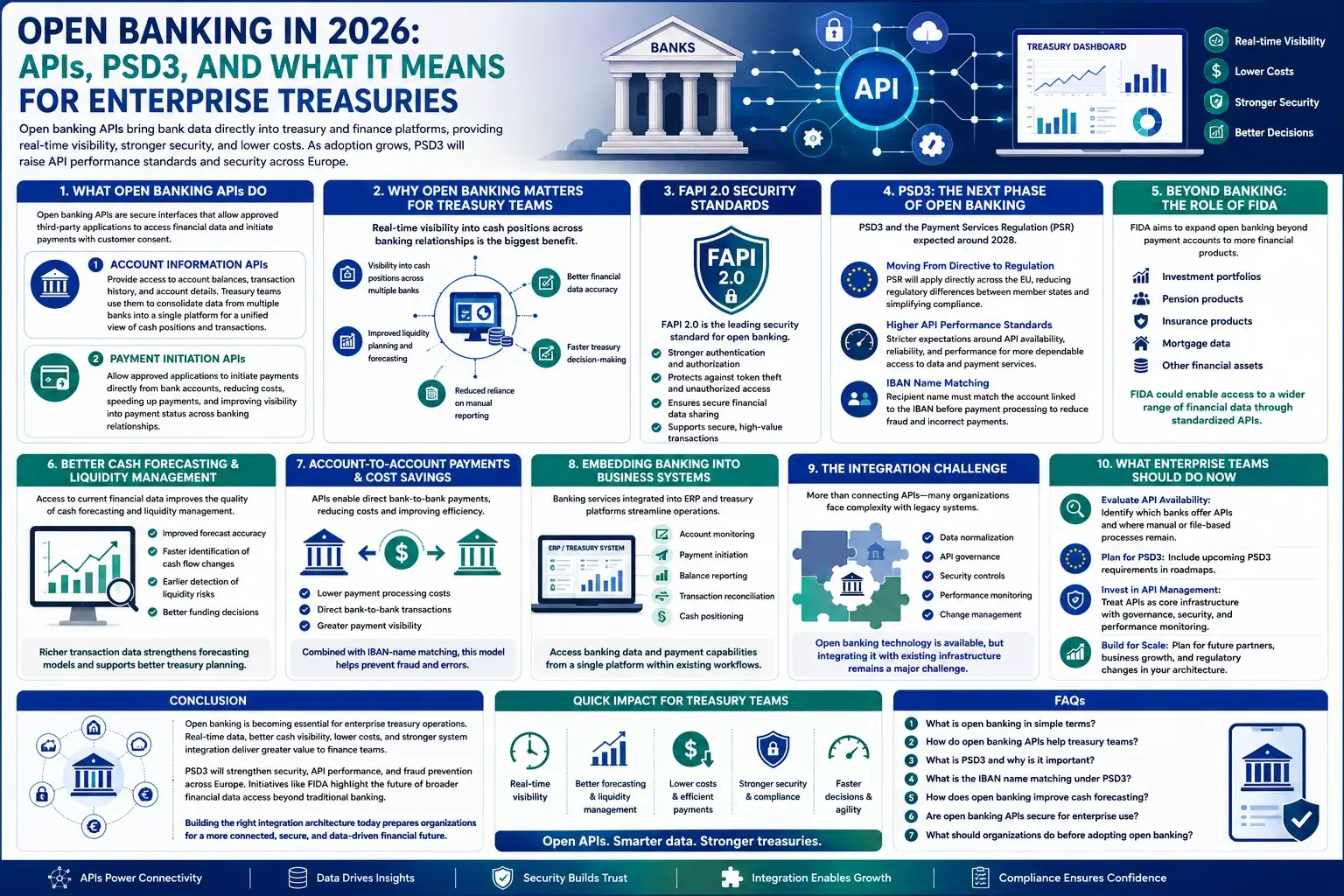
What Open Banking APIs Do
Open banking APIs are secure interfaces that allow approved third-party applications to access financial data and initiate payments with customer consent.
They generally fall into two categories:
1. Account Information APIs
Account Information APIs provide access to account balances, transaction history, and account details. Treasury teams use them to consolidate data from multiple banks into a single platform, giving finance teams a unified view of cash positions and transactions.
2. Payment Initiation APIs
Payment Initiation APIs allow approved applications to initiate payments directly from bank accounts. For businesses, this can reduce transaction costs, speed up payment processing, and provide better visibility into payment status across banking relationships.
Why Open Banking Matters for Treasury Teams
The biggest benefit of open banking for enterprise treasury is real-time visibility into cash positions across banking relationships.
Many treasury teams still rely on manual reporting processes, with data collected from multiple sources and consolidated into spreadsheets. This can create delays and increase the risk of errors. Open banking APIs connect banks directly with treasury management systems, providing access to current financial data and a consolidated view of liquidity.
Key benefits include:
- Visibility into cash positions across multiple banks
- Improved liquidity planning and forecasting
- Reduced reliance on manual reporting
- Better financial data accuracy
- Faster treasury decision-making
The Rise of FAPI 2.0 Security Standards
The Financial-grade API (FAPI) 2.0 profile is becoming a widely adopted security standard for open banking ecosystems. Developed to support secure financial data sharing, it introduces stronger protections against unauthorized access and token theft while strengthening authentication and authorization requirements.
For organizations evaluating treasury platforms, API providers, or banking integrations, FAPI 2.0 compliance is increasingly viewed as an important requirement. It helps protect sensitive financial information and supports secure, high-value transactions across connected banking environments.
PSD3: The Next Phase of Open Banking
PSD3 and the accompanying Payment Services Regulation (PSR) mark the next stage in the evolution of Europe’s open banking framework. Expected to take effect around 2028, the legislation aims to address gaps identified during PSD2 implementation and create a more consistent regulatory environment across EU member states.
Key Changes Under PSD3
- Moving From Directive to Regulation
The Payment Services Regulation (PSR) will apply directly across the European Union, reducing regulatory differences between member states and simplifying compliance for organizations operating across multiple markets. - Higher API Performance Standards
PSD3 introduces stricter expectations around API availability, reliability, and performance. For treasury teams, this means more dependable access to cash balances, transaction data, and payment services. - IBAN Name Matching
Before a payment is processed, the recipient’s account name must match the account linked to the IBAN. This additional verification step helps reduce payment fraud and lowers the risk of funds being sent to incorrect accounts.
Beyond Banking: The Role of FIDA
The Financial Data Access Regulation (FIDA) represents a possible expansion of the open banking model beyond payment accounts. While still under discussion, FIDA aims to support data sharing across a wider range of financial products.
Potential areas of coverage include:
- Investment portfolios
- Pension products
- Insurance products
- Mortgage data
- Other financial assets
For treasury and finance teams, FIDA could provide access to financial information from multiple asset classes through standardized APIs. Although implementation is still some years away, it highlights the growing role of connected financial data across the industry.
Better Cash Forecasting and Liquidity Management
Open banking gives treasury teams access to current financial data, improving the quality of cash forecasting, and liquidity management. Instead of relying on static account balance reports, finance teams can work with more up-to-date information.
Benefits include:
- Improved forecast accuracy
- Faster identification of cash flow changes
- Earlier detection of liquidity risks
- Better funding decisions
Over time, access to richer transaction data can help strengthen forecasting models and support more effective treasury planning.
Account-to-Account Payments and Cost Savings
Payment initiation APIs support account-to-account payments, allowing funds to move directly between bank accounts instead of card networks. This can help businesses reduce transaction costs, particularly when handling large payment volumes.
Key benefits include:
- Lower payment processing costs
- Direct bank-to-bank transactions
- Greater payment visibility
Combined with fraud-prevention measures such as IBAN-name matching, this payment model is gaining attention among enterprise finance and treasury teams.
Embedding Banking into Business Systems
Banking services are increasingly being integrated directly into ERP and treasury platforms, reducing the need to switch between multiple systems.
Common capabilities include:
- Account monitoring
- Payment initiation
- Balance reporting
- Transaction reconciliation
- Cash positioning
By bringing these functions into existing workflows, finance and treasury teams can access banking data and payment capabilities from a single platform.
The Integration Challenge
Open banking adoption often requires more than connecting a few APIs. Many organizations still rely on legacy systems that were not built for modern financial connectivity.
Key areas of focus include:
- Data normalization
- API governance
- Security controls
- Performance monitoring
- Change management
While open banking technology is widely available, integrating it with existing financial infrastructure remains a significant challenge.
What Enterprise Teams Should Do Now
Organizations preparing for the next phase of open banking should start by reviewing their banking relationships and technology capabilities.
Key priorities include:
- Evaluate API Availability: Identify which banking partners offer API connectivity and where manual or file-based processes remain.
- Plan for PSD3: Include upcoming PSD3 requirements in treasury and technology roadmaps.
- Invest in API Management: Treat API connectivity as core treasury infrastructure, supported by governance, security, and performance monitoring.
- Build for Scale: Consider future banking partners, business growth, and regulatory changes when planning integration architecture.
Conclusion
Open banking is becoming an important part of enterprise treasury operations. Access to real-time banking data, improved cash visibility, lower payment costs, and stronger integration with treasury systems are increasing the value of API-based connectivity for finance teams.
PSD3 is expected to strengthen security, API performance, and fraud prevention across European markets. At the same time, initiatives such as FIDA highlight the growing demand for wider financial data access beyond traditional banking services.
FAQs
1. What is open banking in simple terms?
Open banking is a framework that allows customers to securely share banking data with authorized third-party providers through APIs, enabling access to financial services, insights, and payment solutions.
2. How do open banking APIs help treasury teams?
Open banking APIs provide direct access to account balances and transaction data across multiple banks, helping treasury teams improve cash visibility, reduce manual reporting, and support financial planning.
3. What is PSD3 and why is it important?
PSD3 is the European Union’s updated payment services framework. It aims to improve API performance, strengthen security requirements, reduce fraud risks, and create greater consistency across member states.
4. What is the IBAN name matching under PSD3?
IBAN-name matching verifies whether the recipient account name matches the account linked to the destination IBAN before payment processing, helping reduce fraud, errors, and misdirected payments.
5. How does open banking improve cash forecasting?
Open banking provides treasury teams with current account and transaction data, allowing forecasting models to use better inputs and produce more accurate liquidity and cash flow projections.
6. Are open banking APIs secure for enterprise use?
Yes. Open banking APIs use authentication, encryption, consent management, and standards such as FAPI 2.0 to protect financial data and support secure enterprise banking transactions.
7. What should organizations do before adopting open banking?
Organizations should review banking relationships, evaluate available API connectivity, assess security and compliance requirements, and develop an integration strategy aligned with business and treasury objectives.