



Businesses operate in a complex financial environment. Global expansion, fluctuating interest rates, digital payment growth, supply chain pressures, and regulatory requirements have expanded the responsibilities of treasury teams. Treasury is no longer limited to managing cash balances and payments. It now supports liquidity planning, financial risk management, and broader business objectives.
In corporate treasury management 2026, organizations are adopting modern technologies to gain clearer visibility into cash positions and improve forecasting. Automation, data analytics, and AI-driven capabilities are becoming part of daily treasury operations. At the same time, treasury technology tools are giving finance teams access to real-time financial data and deeper insights for decision-making.
This article explores the trends, technologies, and strategies shaping treasury management in 2026.
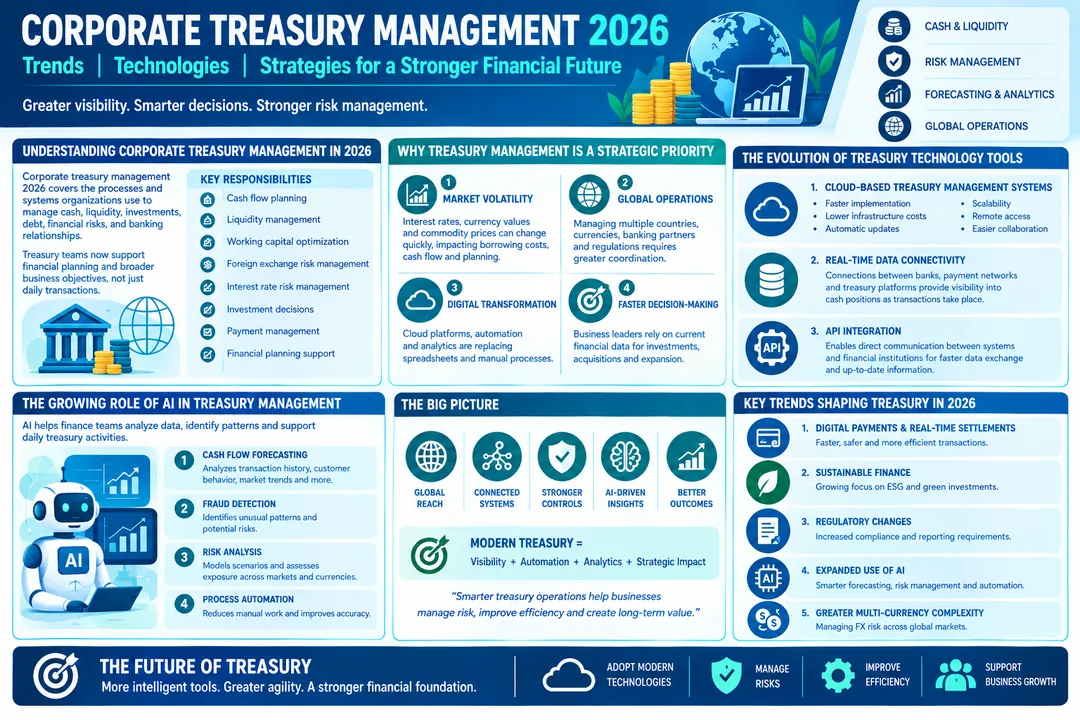
Understanding Corporate Treasury Management in 2026
Corporate treasury management 2026 covers the processes and systems organizations use to manage cash, liquidity, investments, debt, financial risks, and banking relationships.
Treasury teams have traditionally focused on cash management and daily financial transactions. While these responsibilities remain important, treasury departments now play a larger part in financial planning and business operations.
Their responsibilities include:
- Cash flow planning
- Liquidity management
- Working capital optimization
- Foreign exchange risk management
- Interest rate risk management
- Investment decisions
- Payment management
- Financial planning support
With operations spread across multiple markets, currencies, and banking partners, treasury professionals depend on real-time financial data, forecasting tools, and connected systems to monitor cash positions and manage financial risks.
Why Treasury Management Has Become a Strategic Priority
Businesses now depend on treasury teams for more than cash management and payments, making treasury a larger part of financial planning.
1. Market Volatility
Interest rates, currency values, and commodity prices can change within short periods. These fluctuations affect borrowing costs, cash flow, and financial planning. Treasury teams need clear visibility into cash positions and risk exposure to respond effectively.
2. Global Business Operations
Many organizations operate across multiple countries and currencies. Managing banking relationships, regulations, and payment networks requires greater coordination and oversight.
3. Digital Transformation
Finance departments are adopting cloud platforms, automation tools, and data analytics solutions. Treasury functions are also moving away from spreadsheets and manual processes toward modern systems.
4. Demand for Faster Decision-Making
Business leaders rely on current financial data when evaluating investments, acquisitions, funding requirements, and expansion opportunities. Treasury teams provide the information needed to support these decisions.
The Evolution of Treasury Technology Tools
Over the past decade, treasury technology tools have changed how organizations manage cash, payments, financial risks, and forecasting. Instead of relying on disconnected systems and spreadsheets, many companies now use platforms that bring together data from banks, ERP systems, accounting software, and payment networks.
1. Cloud-Based Treasury Management Systems
Cloud-based treasury systems have become a common choice for finance teams. Their benefits include:
- Faster implementation
- Lower infrastructure costs
- Automatic updates
- Scalability
- Remote access
- Easier collaboration
These platforms give treasury teams access to financial data across locations and business units.
2. Real-Time Data Connectivity
Treasury teams need access to current financial information. Connections between banks, payment networks, and treasury platforms provide visibility into cash positions as transactions take place.
3. API Integration
APIs enable direct communication between treasury systems and financial institutions. This allows faster data exchange, reduces reliance on file transfers, and provides access to up-to-date financial information.
The Growing Role of AI in Treasury Management
Finance teams use AI to analyze financial data, identify patterns, and support daily treasury activities.
1. Cash Flow Forecasting
Cash flow forecasting is one of the most common uses of AI in treasury. Instead of relying only on historical records and manual estimates, AI can analyze:
- Transaction history
- Customer payment behavior
- Seasonal trends
- Market conditions
- Business activity
This provides treasury teams with more reliable cash flow projections.
2. Risk Detection
Treasury teams monitor fraud, liquidity risks, currency exposure, and market fluctuations. AI-powered systems can flag unusual transactions and highlight potential risks that require further review.
3. Decision Support
AI can evaluate large volumes of financial data and present recommendations related to:
- Investment planning
- Debt management
- Cash allocation
- Currency hedging
Treasury professionals review these insights and make the final decisions.
Key Treasury Strategies for 2026
Organizations also need strategies that support financial operations and business objectives.
1. Building a Centralized Treasury Structure
Many companies manage treasury activities through a centralized model. This approach can provide:
Better cash visibility
Consistent policies
Reduced duplication of tasks
Greater control over financial resources
Large organizations often use treasury centers to manage operations across multiple regions.
2. Improving Cash Visibility
Access to current cash data is a priority for treasury teams. Many organizations use tools that offer:
Real-time cash positions
Multi-bank reporting
Cross-border account visibility
Centralized dashboards
This information supports daily cash management and funding decisions.
3. Optimizing Working Capital
Treasury teams work closely with accounts payable, accounts receivable, and procurement functions. Common approaches include reducing payment delays, improving collections, reviewing supplier terms, and monitoring inventory levels.
4. Strengthening Risk Management
Treasury departments monitor currency risk, interest rate risk, credit risk, counterparty risk, and liquidity risk. Data analytics and forecasting tools help teams assess potential financial exposures and prepare different market conditions.
Treasury and Digital Payments
Digital payments are now part of everyday business operations. As transaction volumes grow across payment channels, treasury teams need greater visibility and control over payment activity.
1. Faster Payment Networks
Real-time payment systems are expanding across global markets. These networks allow funds to move between accounts within seconds, reducing transaction delays and giving treasury teams quicker access to cash movement data.
2. Cross-Border Payment Innovation
International payments have often involved higher costs and longer processing times. New payment technologies are improving transaction visibility and speeding up fund transfers across different markets.
3. Payment Security
As digital payment volumes grow, security remains a major priority. Treasury teams invest in:
Multi-factor authentication
Payment controls
Fraud monitoring tools
Transaction verification systems
Data Analytics and Treasury Performance
Financial information from banks, ERP systems, and payment platforms helps treasury teams monitor cash positions and track performance.
1. Treasury Dashboards
Treasury platforms provide dashboards that display:
Cash balances
Liquidity positions
Debt exposure
Risk metrics
Forecast results
These dashboards give finance teams a consolidated view of treasury activities.
2. Scenario Planning
Treasury teams use scenario analysis to evaluate the impact of:
Interest rate changes
Currency movements
Economic downturns
Revenue fluctuations
This approach supports financial planning under different conditions.
3. Performance Measurement
Treasury departments monitor metrics such as forecast accuracy, liquidity levels, payment processing performance, working capital metrics, and cost reductions. These measures help track treasury performance over time.
Challenges Facing Treasury Teams in 2026
Treasury departments continue to face operational and technology-related challenges.
1. Managing Data Quality
Treasury activities depend on reliable financial data. Information often comes from multiple systems, banks, and business units, making data accuracy and consistency ongoing concerns.
2. System Integration
Many organizations use a mix of legacy infrastructure and newer treasury platforms. Connecting these systems can require considerable planning, investment, and internal resources.
3. Talent Development
Treasury professionals are expected to work across several areas, including:
Financial analysis
Treasury technology
Data analytics
Risk management
Financial planning
4. Regulatory Requirements
Financial regulations vary across markets and continue to change. Treasury teams must monitor reporting obligations, compliance requirements, and documentation standards to avoid operational and financial risks.
What the Future Holds for Corporate Treasury Management
The future of corporate treasury management in 2026 is closely tied to automation, analytics, and connected financial systems. Real-time data, forecasting tools, and AI capabilities are becoming standard features of treasury operations.
Organizations that invest in treasury technology tools can gain better visibility into cash, liquidity, and financial risks. As treasury responsibilities continue to expand, teams will play a larger part in financial planning and business decision-making.
Conclusion
Corporate treasury management 2026 extends beyond cash management and banking relationships. Treasury teams are using data, automation, and treasury technology tools to manage liquidity, monitor risks, and support financial planning.
Cloud platforms, real-time connectivity, and AI capabilities are changing how treasury operations are handled. Although challenges such as data quality, system integration, and regulatory requirements remain, organizations are adopting new tools and processes to manage treasury activities with greater accuracy and visibility.
FAQs
1. What is corporate treasury management in 2026?
Corporate treasury management in 2026 covers cash management, liquidity planning, debt management, payments, investments, and financial risk oversight. Treasury teams use technology platforms and data insights to support day-to-day financial operations.
2. How is AI being used in treasury management?
AI is used to analyze transaction data, forecast cash flows, detect unusual payment activity, and identify financial patterns. Treasury teams use these insights when reviewing liquidity, risks, and funding requirements.
3. Why are treasury technology tools important for businesses?
Treasury technology tools provide visibility into cash positions, banking activity, payments, and financial exposures. They also reduce manual work by connecting treasury operations with banking, accounting, and ERP systems.
4. What are the biggest treasury challenges in 2026?
Treasury teams face challenges related to data quality, system integration, regulatory compliance, financial risk management, and workforce skills. Managing information from multiple banks and platforms remains a common concern.
5. How do cloud-based treasury management systems help organizations?
Cloud-based treasury systems give finance teams access to treasury data from different locations. They support system updates, lower infrastructure requirements, and provide a centralized platform for treasury activities.
6. What role does cash flow forecasting play in treasury operations?
Cash flow forecasting helps organizations estimate future cash inflows and outflows. Treasury teams use forecasts to plan funding requirements, monitor liquidity levels, and manage short-term financial obligations effectively.
7. How can companies improve treasury performance?
Companies can improve treasury performance by improving cash visibility, monitoring financial risks, using connected treasury platforms, reviewing working capital regularly, and tracking performance metrics tied to treasury activities.