

Introduction
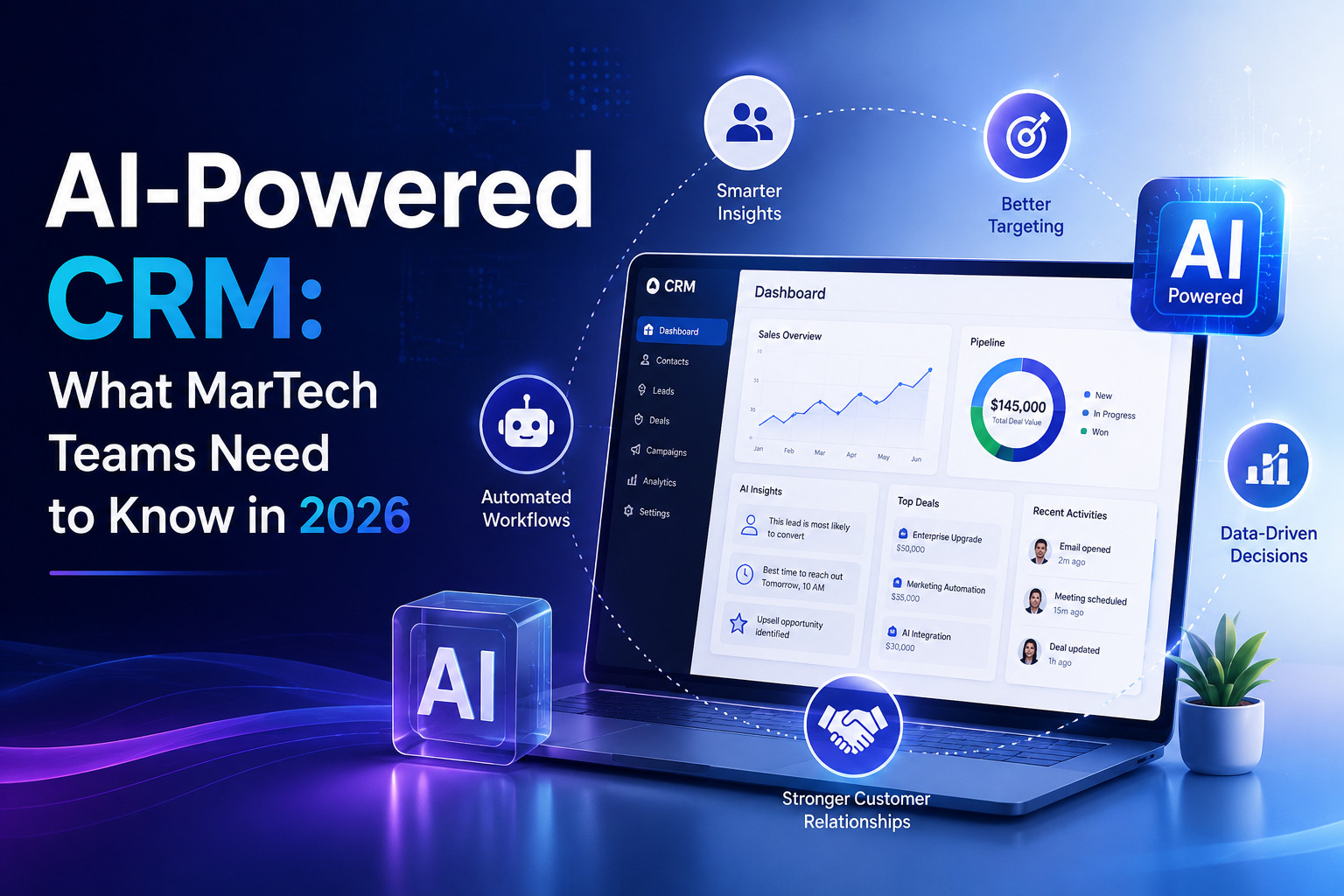
CRM platforms were once used mainly for storing data. They held contact details, call notes, and deal stages. The value they delivered depended heavily on manual data entry, which often limited their usefulness. That model has changed. In 2026, CRM systems act as the core of marketing operations, powered by artificial intelligence. They can predict customer behavior, identify risks such as churning, and personalize communication at a scale.
Instead of just storing data, they actively guide decisions and actions across marketing and sales teams. The global CRM market is expected to reach $126.2 billion in 2026, with continued strong growth. AI features are expanding even faster within this space. Most organizations already use some form of AI in their CRM workflows. The question now is how effectively those capabilities are being used.
What AI Is Doing Inside CRM Platforms
AI-powered CRM functions can be grouped into three main areas: prediction, personalization, and automation. Each plays a role in making CRM systems more dynamic and effective.
Predictive Analytics
Predictive lead scoring is one of the most widely used AI features. It analyzes past customer data to identify which leads are most likely to convert. Instead of relying on static rules, machine learning models evaluate patterns across multiple signals. This helps sales teams focus on high-value opportunities and improve pipeline efficiency.
Churn prediction works in a similar way. CRM systems analyze behavior, engagement, and usage patterns to identify customers who may leave. This allows businesses to act before the customer makes a decision, improving retention rates.
Personalization at Scale
AI enables personalization far beyond basic segmentation. It tailors messages, offers, and communication channels for individual customers.
CRM systems can determine the best time to reach a customer, the most effective message, and the channel most likely to drive engagement. This level of personalization helps improve open rates, click-through rates, and overall campaign performance.
Automated Actions
AI-powered CRM systems also automate workflows. When a lead score changes or a customer’s behavior signals risk, the system can trigger actions immediately. These may include sending an email, assigning a sales representative, or starting a targeted campaign. Faster response times lead to better engagement and improved outcomes across the customer lifecycle.
The Data Quality Challenge
AI performance depends heavily on data quality. This remains one of the biggest challenges for MarTech teams.
Why Data Quality Matters
Many organizations operate with incomplete or outdated CRM data. Missing fields, duplicates, and inconsistent records are common issues. When AI models rely on this data, the outputs can be misleading. Predictions may look accurate but may not reflect real customer behavior.
Impact on AI Performance
Unlike rule-based systems, AI models learn from patterns. Poor data leads to incorrect patterns, which affects predictions and recommendations. This creates a risk where decisions are based on flawed insights, reducing the value of AI investments.
Improving Data Foundations
To improve outcomes, teams need to focus on:
- Data validation during entry
- Regular cleaning and deduplication
- Enrichment from reliable sources
- Clear ownership of data quality
Data management should be treated as an ongoing process, not a one-time effort.
The Shift Toward Stack Consolidation
The marketing technology landscape is becoming more consolidated. Companies are reducing the number of tools they use and relying more on core platforms such as CRM.
Why Consolidation Matters
Many organizations still operate with fragmented systems. Customer data often exists across multiple platforms, leading to inconsistencies. When AI systems operate on disconnected data sources, they produce inconsistent insights. This limits their effectiveness.
The Role of CRM as a Central Platform
Modern CRM systems are expanding to include marketing automation, analytics, and customer data management. Using a single source of truth for customer data improves consistency and allows AI models to work with complete datasets.
Benefits of Unified Data
- Better accuracy in predictions
- Improved personalization
- Reduced duplication
- Lower operational complexity
Teams that rely on first-party data within a unified system often see higher customer lifetime value and lower acquisition costs.
Agentic AI in CRM
The next stage of CRM evolution involves AI systems that can act independently within defined boundaries.
From Recommendations to Actions
Traditional AI provides insights and suggestions. Agentic AI goes further by executing actions based on those insights. For example, instead of flagging a high-risk customer, the system can initiate outreach, select the communication channel, and adjust messaging based on responses.
Use Cases in 2026
AI agents are being used in areas such as:
- Campaign optimization
- Lead qualification
- Customer communication
- Proposal generation
These systems can operate continuously, making adjustments based on performance signals.
Governance Considerations
While agentic AI increases efficiency, it also introduces risk.
Organizations must define:
- Decision boundaries
- Approval requirements
- Data access limits
- Monitoring and audit mechanisms
Clear governance helps maintain control and accountability.
What MarTech Teams Should Focus On
Many teams are still in early stages of AI adoption. To maximize value, focus should remain on key operational areas.
Strengthen Data Quality
AI performance improves significantly when data is accurate and complete. Teams should prioritize cleaning existing data and building processes that maintain quality over time.
Reduce Stack Complexity
Instead of adding more tools, organizations should focus on improving integration and reducing data fragmentation. A smaller, well-connected stack delivers better results than a large disconnected one.
Build Governance Early
Before scaling AI capabilities, teams need clear guidelines for how systems operate. This includes defining when human involvement is required and how decisions are tracked.
Align Teams and Processes
AI-powered CRM impacts sales, marketing, and customer success teams. Alignment across these functions helps maximize the value of AI insights and actions.
Measuring Success
To evaluate AI-powered CRM performance, teams should track:
- Conversion rates
- Customer retention
- Campaign engagement
- Response times
- Revenue impact
Continuous monitoring allows teams to refine models and improve results over time.
Common Mistakes to Avoid
Some common issues in AI CRM adoption include:
- Relying on poor-quality data
- Using disconnected systems
- Over-automating without control
- Ignoring governance requirements
Avoiding these mistakes helps organizations get better outcomes from their investments.
The Bottom Line
AI-powered CRM is not a future concept. It is already embedded in most platforms used by marketing teams today. The difference in results comes from how effectively it is used. Teams that focus on data quality, system integration, and governance are able to extract greater value.
As AI capabilities continue to grow, CRM systems will become even more central to customer engagement strategies. Organizations that build strong foundations now will be better positioned to benefit from these advancements.
FAQs
1. What is AI-powered CRM?
AI-powered CRM refers to customer relationship management systems that use artificial intelligence to analyze data, predict behavior, automate workflows, and personalize customer interactions. These capabilities help improve marketing efficiency and support better decision-making across customer-facing teams.
2. How does AI improve lead management in CRM?
AI improves lead management by analyzing past data to predict which leads are most likely to convert. It prioritizes prospects, helping sales teams focus on high-value opportunities, and reducing time spent on low-potential leads.
3. Why is data quality important in AI-powered CRM systems?
Data quality directly affects AI outputs. Incomplete or inaccurate data leads to unreliable predictions and recommendations. Clean and structured data allow AI models to produce accurate insights that support effective decision-making.
4. What is personalization in AI-powered CRM?
Personalization involves tailoring messages, timing, and channels based on individual customer behavior. AI analyzes preferences and activity to deliver targeted content that improves engagement and increases conversion rates.
5. What is agentic AI in CRM?
Agentic AI refers to systems that can act independently based on predefined rules. These systems can initiate actions such as sending messages or adjusting campaigns without manual input, while still operating within defined governance limits.
6. What are the risks of using AI in CRM?
Risks include poor data leading to incorrect predictions, lack of transparency in decisions, and over-automation. Without proper oversight and governance, AI systems can produce results that negatively affect customer experience or compliance requirements.
7. How should companies start using AI in CRM?
Companies should begin by improving data quality, selecting key use cases such as lead scoring or churn prediction, and gradually scaling AI capabilities. Establishing governance and monitoring processes helps manage risk as adoption increases.